



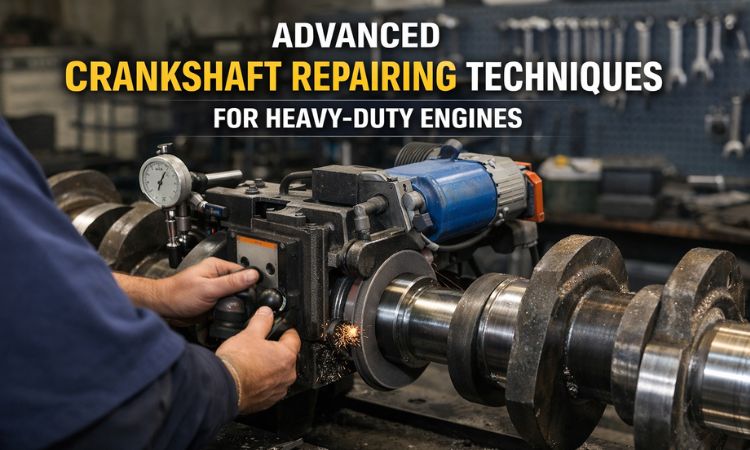
Advanced crankshaft repair techniques play an important role in maintaining the performance and reliability of heavy-duty engines. The crankshaft is one of the most critical components in an engine because it converts piston motion into rotational power. Over time, heavy loads, friction, and poor lubrication can cause wear, cracks, or misalignment in the crankshaft. Instead of replacing the entire component, modern repair methods allow technicians to restore the crankshaft efficiently. In this blog, we will explore advanced crankshaft repair techniques, common crankshaft failures, repair processes, and the tools used to restore heavy-duty engines.
What Is Crankshaft Repairing and Why Does It Matter?
Crankshaft repairing is a long process where you restore your worn, damaged, misaligned crankshaft to its correct operating condition. The crankshaft is known for converting the linear motion of pistons into rotational motion. Thus, helping your vehicle’s engine to generate power. There is no doubt that the crankshaft is constantly under high pressure and torque. This, in turn, makes the crankshaft one of the most stressed components in any engine.
Over time, when the crankshaft becomes damaged, the efficiency of your engine keeps decreasing. This may lead to severe mechanical failures and this is exactly when repairing is required. Getting your crankshaft repaired at the right time not only helps in preventing further damage to bearings and connecting rods. But also sparing other internal engine components from getting damaged.
The modern crankshaft repairing techniques are quite popular these days. They make sure that your crankshaft’s damaged journals, minor cracks, and alignment issues are carefully corrected. That too, without having to replace the entire shaft. This not only reduces repair costs but also saves valuable operational time for industries that rely on heavy machinery.
Common Crankshaft Failures in Heavy-Duty Engines
Here are the common types of crankshaft failure in heavy-duty engines:
Journal Wear and Scoring
Journal wear is one of the most common problems one faces with their engine crankshaft. The crankshaft journals happen to be the surface that rotates with the bearings. Over time, with inadequate lubrication, contamination, or heavy loads, these journals wear down or sometimes develop deep scoring marks.
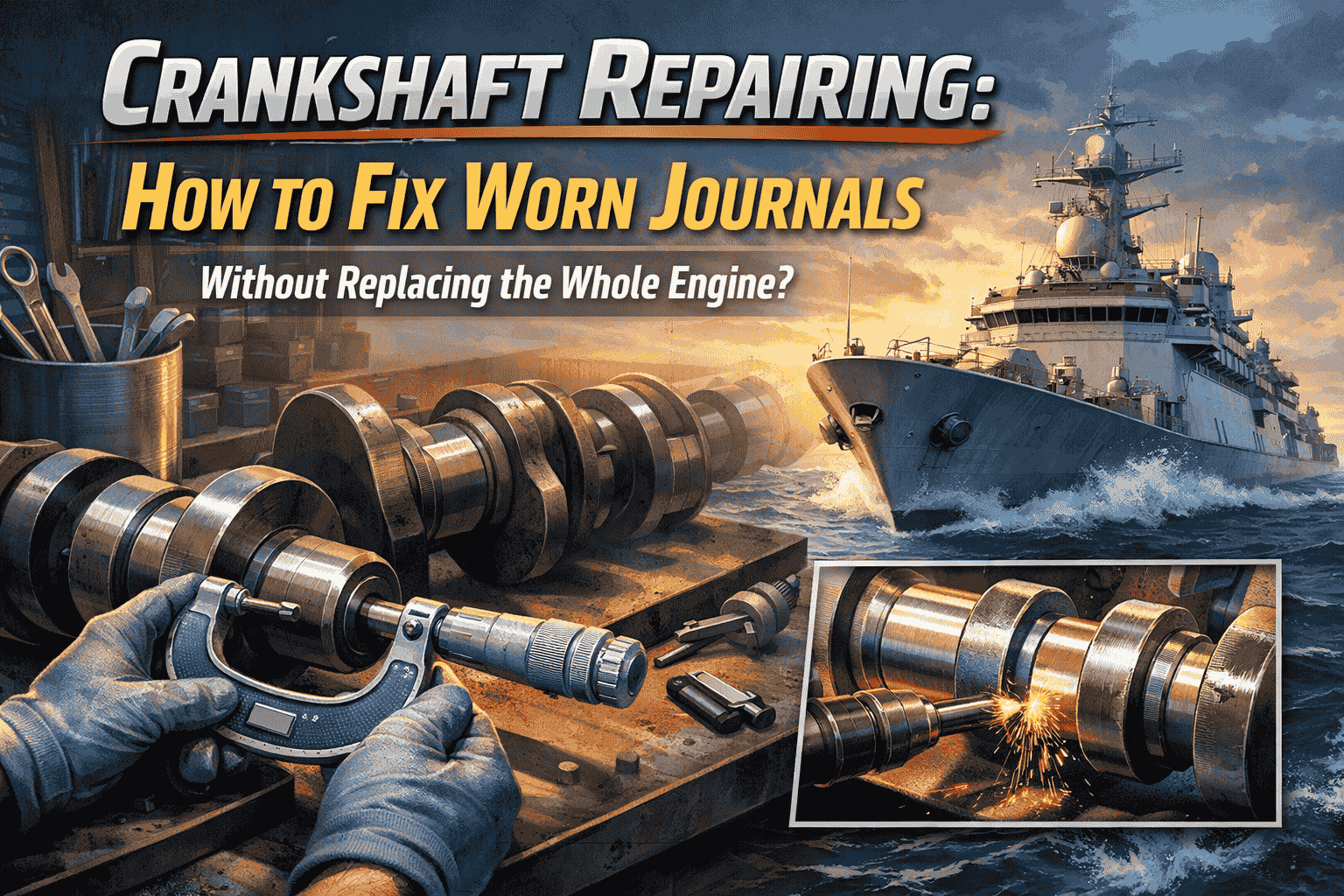
The damage to your crankshaft journals can not only lead to disruption of your smooth crankshaft rotation but also lead to excessive vibration or overheating. If such a case happens, the crankshaft journals are repaired by performing precision grinding or polishing techniques. In order to restore the journal surface to the required dimensions and smoothness. This process is also known as crankshaft journal repair, and it is a critical step in full engine crankshaft repair.
Cracks and Fatigue Fractures
Cracks are a sign of long-term damage due to fatigue; they can also happen due to sudden overload or manufacturing defects. Even the small cracks can expand rapidly if they suffer repeated engine stress. That eventually can cause catastrophic engine failure.
That is why detecting these cracks in the early stages is very necessary. Methods like magnetic particle inspection or ultrasonic testing are used, which allow engineers to repair the damage before it becomes severe. Full engine crankshaft repair techniques like metal stitching or specialised welding processes are commonly used for restoring the structural strength of your crankshaft.
Misalignment and Bending
This is yet another common problem that a crankshaft goes through: misalignment and bending. Misalignment and bending are usually a result of improper installation, sudden engine seizure, or heavy impact loads. When you have a bent crankshaft, it can lead to uneven engine operations, excessive vibrations, and premature bearing wear.
Precision alignment tools and corrective machining are generally used for restoring the crankshaft to its correct geometrical shape. Thus, making sure there is a smooth and balanced engine performance.
Step-by-step Crankshaft Repairing Process:
Repairing the crankshaft requires you to have not only a proper knowledge of technical expertise, but also specialised equipment. But you also need to have knowledge about the systematic approach.
Here is a step-by-step crankshaft repairing process:
Inspection and Damage Assessment
The first step in the crankshaft repairing process is inspection. The engineers usually examine the crankshaft visually and with advanced diagnostic tools to identify wear, cracks, or alignment problems. Notably, these cracks are not visible to the naked eyes and taken by using micrometres and dial gauges
In-Situ Grinding of Crankshaft Journals
In-Situ Grinding is a direct on-site repair method for the damaged journals at the site. There is no need to dismantle and transport the entire engine to a workshop. Instead, all the technicians need is a portable grinding machine mounted directly onto the crankshaft to precisely grind the damaged surfaces. It maintains both journal diameter and surface finish requirements. Results? Less downtime and fast repairing.
Metal Stitching For Crack Repair
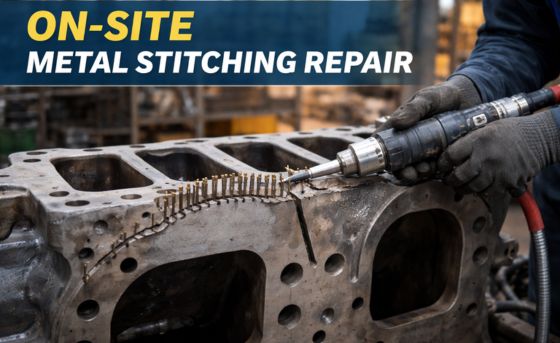
The Metal stitching process uses metal rods, clamps, and bolts to stitch the damaged part for enhanced performance. Unlike traditional welding, the metal stitching technique does not need excessive heat in the metal structure of the crankshaft. Instead it uses specialised metal as locks and pins and inserts them along the crack, ensuring resistance to operational stress and preventing the crack spreading.
Surface Hardening and Finishing
Once the grinding and structural repairing are completed, the next step is to care about the crankshaft’s durability. Surface hardening techniques increase resistance to wear and fatigue.
In-Situ vs. Workshop Crankshaft Repairing: Which is Better?
Aspect | In-Situ Repair | Workshop Repair |
Process | Uses portable tools to grind/polish journals directly in the engine. | Need the removal of the crankshaft to the workshop alongside heavy equipment. |
Best For | Mild-moderate damage, large engines, low downtime tolerance (e.g., marine/power). | Severe damage needing precision/high-load tools or full inspection. |
Downtime | Minimal (hours/days); engine stays in place. | Weeks due to disassembly, shipping, reinstallation. |
Cost | Lower (no transport and disassembly) | Higher because of logistics, labor, and facility fees. |
Precision | High with advanced portable gear; meets OEM specs. | Superior for complex cases via controlled environments. |
Logistics | On-site; technicians travel to site globally. | Requires crane/truck for heavy components. |
Tools and Equipment Used in Advanced Crankshaft Repair:
Here are some of the tools required in Advanced Crankshaft Repair:
- Portable Grinding Machines:
Provide in-situ journal restoration, grinding and polishing directly on the engine without disassembly.
- Dial Indicators:
Measure runout, alignment, and concentricity with high accuracy.
- Micrometers:
Measure journal diameters and final dimensions.
- Ultrasonic Testing Devices:
To detect internal cracks and subsurface defects.
- Magnetic Particle Inspection Systems:
Reveal surface and near-surface cracks.
- CNC Crankshaft Grinding Machines:
Useful for complex shapes, features electronic controls and high-precision feeds.
- Crankshaft Polishing Machines:
Polishes the final finish, include cast-iron bases and cooling systems for durability.
When to Repair vs. Replace a Crankshaft?
Your technicians will decide whether to repair the journals or you need to totally replace the crankshaft. They will do that by assessing the damage severity of the journals and structural integrity and operating requirements.
If your crankshaft has some minor or small cracks, they can often be corrected by precision crankshaft repairing methods. However, if there is severe bending, extensive cracking or major weakness, you might need to change the entire crankshaft.
Why Choose Professional Crankshaft Repairing Services?
A professional crankshaft repairing service provides you with the best and most experienced technicians with advanced diagnostic tools and precision machining capabilities. Notably, these technicians are often experts who follow strict measurement procedures in order to maintain proper alignment and ensure accurate grinding throughout repairs.
This overall reduces downtime and prevents repeated failures but also delivers dependable results. Thus, improving engine performance reliability and long‑term operational efficiency for heavy‑duty applications.
Conclusion:
The crankshaft repair helps in extending the life of your engine, reducing downtime, and also helps in avoiding costly replacements later. As damages are very common in the industrial operations, dismantling and transporting the whole machine for minor cracks costs you time, money, and human resources losses. The advanced crankshaft repair with the modern techniques and skilled technicians, offers quick, efficient, and accurate on-site repair procedures. In this blog, we have discussed Crankshaft Repairing, common damages, repairing process, when to choose it, and the tools used.
FAQs:
Q1. What is the cost of crankshaft repairing for heavy-duty engines?
The cost of a crankshaft repair varies depending on the engine size, damage severity, and repair method. But it is usually far lower than a full crankshaft replacement.
Q2. How long does the crankshaft repair process take on-site?
The on-site crankshaft repairing usually takes a few hours to a couple of days. It all depends on the damage level and engine complexity.
Q3. Can crankshaft repairing be done without removing the engine?
Yes, the modern in-situ crankshaft repairs allow you to repair the crankshaft without even removing the engine.
Q4. What are the signs that a crankshaft needs immediate repair?
Your crankshaft shows some of the common signs when it gets damaged. It includes engine vibration, knocking sounds, overheated bearings, reduced performance, and metal particles in engine oil.
Q5. Is in-situ crankshaft repairing as reliable as workshop repairing?
Yes, if it is done by a skilled professional with proper equipment. In-situ crankshaft repairing can be as reliable as workshop repairs.




No Comments