



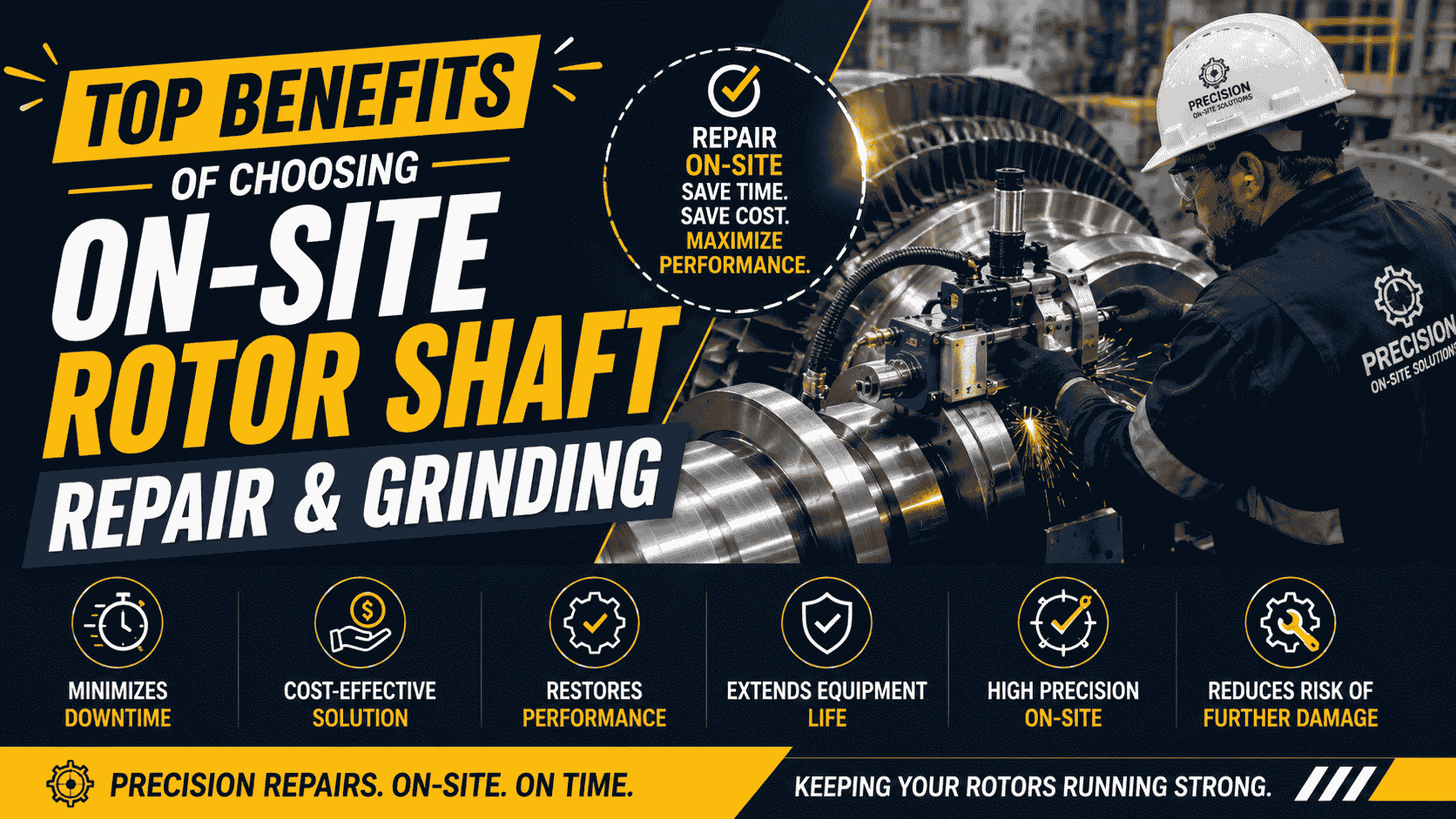
11 May Top Benefits of Choosing On-site Rotor Shaft Repair & Grinding
Industrial machinery does not wait. A small fault in a rotor shaft can stop entire operations and lead to heavy financial losses. Here, if you prefer traditional repair methods, they often cause additional delays because it requires equipment to be taken apart before being moved and put back together.
Many industries today prefer onsite rotor shaft repair & grinding services. This brings expert repair to the machine site, creating a reliable solution that operates with minimal disruption and delivers efficient results.
Here, we will discuss the top benefits of choosing on-site rotor shaft repair & grinding in detail.
What Is Onsite Rotor Shaft Repair & Grinding?
On-site rotor shaft repair and grinding enables you to fix damaged rotor shafts directly at your operational locations. There is no need to move any machinery here. You have to use advanced portable grinding machines with precision tools to achieve restoration of the shaft to its original specifications.
In on-site rotor shaft repair & grinding, inspection, surface grinding and polishing, and alignment correction are included. It achieves its goal by enabling the rotor shaft to regain proper dimensions and operational capacity without using workshop repairs.
Benefits of Choosing On-site Rotor Shaft Repair & Grinding
Here are the benefits of choosing on-site rotor shaft repair & grinding:
- Eliminates Costly Equipment Downtime
Sometimes, you experience your greatest financial losses from equipment downtime. The machine breakdowns lead to a complete work stoppage, which results in decreased revenue. The onsite repair method enables you to conduct immediate repairs, which eliminates extended equipment outages.
You can begin your work immediately instead of waiting for several days until workshop repairs become available. The procedure minimizes downtime, which enables you to restore its operations within a brief period, thereby preventing substantial financial losses.
- Saves Significant Transportation & Logistics Costs
Moving heavy rotor shafts to a workshop incurs high costs and dangerous conditions. Transporting heavy items requires multiple steps, which include dismantling and packaging, equipment lifting, and shipping, resulting in increased overall expenses.
Onsite rotor shaft repair eliminates the requirement for complete transportation. It occurs at the location, which results in decreased transportation expenses and decreased costs for moving materials. It works as an effective method for handling large machinery, especially those that contain intricate components.
- Faster Turnaround Time Compared to Workshop Repairs
Generally, the workshop rotor shaft repair process requires additional time because here you have to wait for repair access, move equipment and put it back in place. On-site repair services enable you to achieve your objectives more quickly.
You’ll get the technicians who possess expertise complete their tasks after arriving with the necessary equipment for grinding and repair work. The quick service enables you to resume your normal activities because it prevents unnecessary work delays.
- Repairs Are Done in Real Operating Conditions
On-site repair enables you to execute your work within the actual workspace of the machinery. You can observe actual operating conditions because they can measure load, alignment, and vibration.
This enables you to conduct repairs with greater accuracy and practical results. It establishes performance standards through real-time data analysis, which enhances operations and decreases future failure risk.
- Reduces Risk of Secondary Damage During Transit
Heavy equipment transportation operations create various hazards that you must manage. Transportation exposes rotor shafts to potential scratches, misalignment, and extra damage.
The equipment stays where it is because of on-site repair works. It protects the shaft from additional damage because it eliminates the need to handle the equipment. This ensures repair operations happen in a secure environment, which protects all machine components.
- Highly Skilled Technicians with Specialized Equipment
If you perform on-site repair work, you get experience in precision grinding and shaft restoration. You can operate portable machines that provide advanced design to achieve maximum precision.
You can adhere to established quality standards while you utilize contemporary tools to obtain accurate measurements. You should ensure that the shaft restoration process complies with original equipment specifications and delivers optimal performance.
- Suitable for a Wide Range of Industries
Onsite rotor shaft repair is not limited to one sector. It finds use in various industrial applications, which include power plants, marine operations, cement production, steel manufacturing, oil and gas extraction, and general manufacturing.
Any industry that depends on rotating equipment can benefit from this service. Its flexibility and adaptability make it a preferred choice across different industrial applications.
- Extends the Overall Lifespan of Your Machinery
The life of rotor shafts becomes shorter through regular wear and tear. The ongoing problem grows into a major failure when you choose to ignore the initial minor problems.
On-site repair establishes the shaft’s original condition while stopping additional equipment failures. Your equipment lifespan increases because of this process, which shows to be a cost-effective solution for permanent use.
When Should You Consider Onsite Rotor Shaft Repair?
The selection of on-site repair requires proper timing because it helps to prevent costly equipment failures.
Here are the situations when should you consider onsite rotor shaft repair:
- Visible Wear or Surface Damage
Your shaft needs immediate repair because it shows signs of damage through scratching, grooving, and uneven surface areas.
- Excessive Vibration in Machinery
Unusual vibrations indicate that your equipment needs alignment correction and shaft damage repair, which can be accomplished through on-site grinding.
- Frequent Equipment Breakdowns
The repeated breakdowns point to hidden shaft problems that need to be fixed through specific repair methods performed on the site.
- Misalignment or Imbalance Issues
The machine operation problems may result from shaft imbalance, which you can resolve through on-site repair methods.
- Need for Immediate Repair Without Shutdown
The onsite repair solution delivers fast and effective maintenance work when operational shutdowns are impossible to implement.
Conclusion
Onsite rotor shaft repair offers you a smart and effective solution that helps industries minimize operational downtime while achieving cost savings and uninterrupted business functions. It provides you high-precision results through on-site repairs, which also eliminates transportation needs and delivers quicker repair times.
You must choose on-site repair because it helps you solve current shaft problems while your machines operate better and your equipment runs longer. This establishes itself as a dependable solution that maintains operational efficiency and drives continuous productivity.
FAQs
- What types of rotor shafts can be repaired onsite?
Generally, the industrial rotor shafts used in turbines, compressors, motors, and pumps can be repaired onsite. They use advanced grinding tools.
- How long does an on-site rotor shaft grinding process typically take?
The on-site rotor shaft grinding process typically takes a few hours to a couple of days. It depends on damage severity.
- Is on-site repair as precise and reliable as workshop-based repair?
Yes, modern onsite equipment and skilled technicians ensure high precision and results equal to or better than workshop repairs.
- What industries benefit the most from on-site rotor shaft repair services?
The power generation sector and marine industry, together with oil and gas, cement, and manufacturing sectors, benefit the most from on-site rotor shaft repair services.
- How do I know if my rotor shaft needs repair or a full replacement?
If damage is minor or moderate, repair is enough, severe cracks or structural failure may require full replacement.
No Comments