



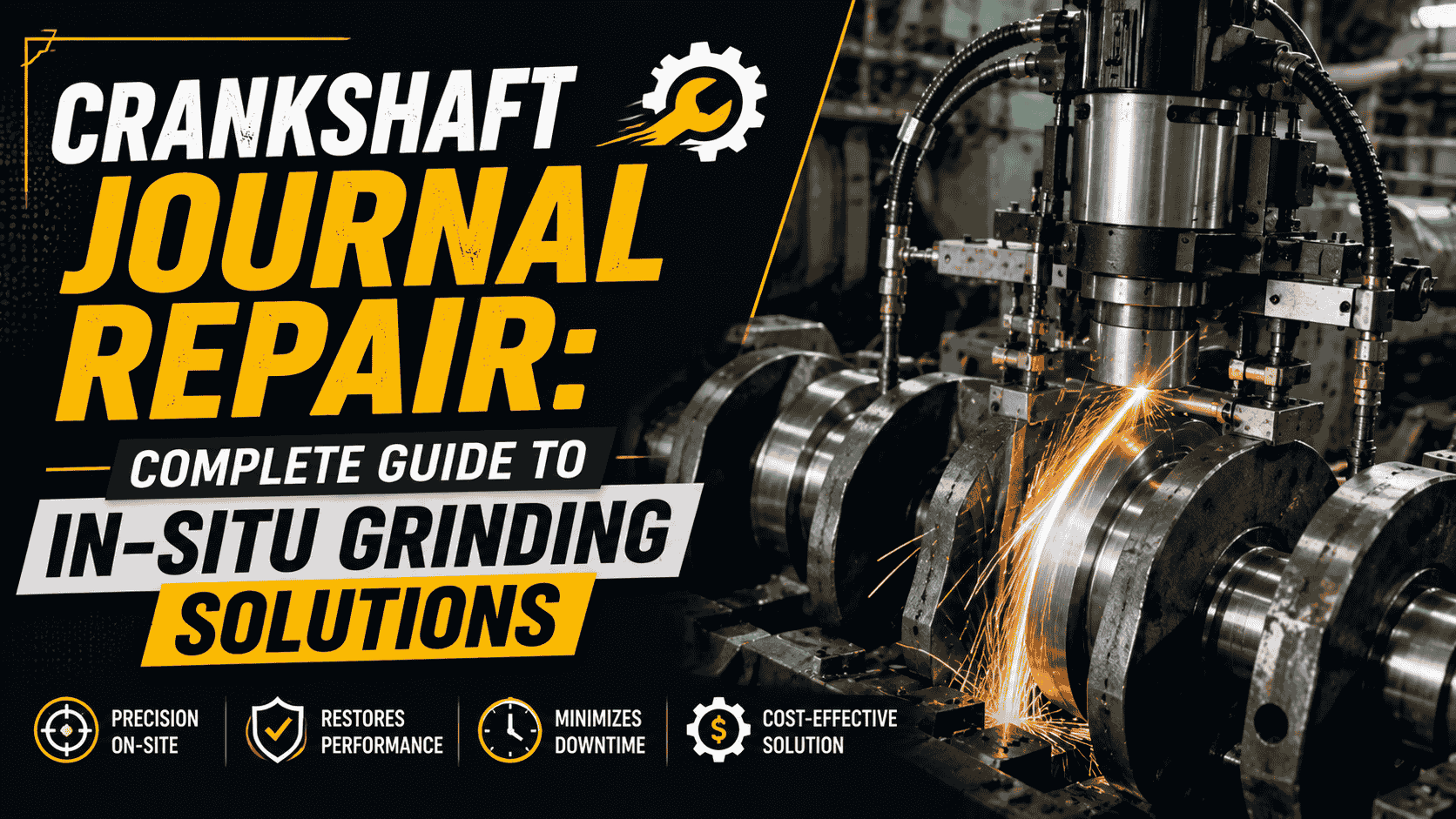
12 May Crankshaft Journal Repair: Complete Guide to In-Situ Grinding Solutions
Crankshaft journal wear often means costly replacement or full dismantling. But in-situ grinding repairs it on-site, no removal needed. The crankshaft enables heavy machinery to generate power and operate marine engines and industrial equipment. They develop wear problems, which result in engine performance issues and reliability problems because of continuous load, friction, and inadequate lubrication.
This in-situ crankshaft journal repair method provides you an effective solution and enables you to perform repairs on site. You don’t need to dissemble the machine too.
This saves your time and costs while you achieve the precise repair and finishes.
What Is a Crankshaft Journal? Why Does It Wear Out?
The crankshaft journal is a polished surface that helps engine bearing to support the crankshaft movement. It operates with design specifications that enable it to withstand heavy loads while producing minimal resistance.
Signs That Your Crankshaft Journal Needs Repair:
Here are the signs that your crankshaft journal needs repair:
- The engine produces unusual knocking or vibration sounds, which show that the journal has experienced unbalanced wear.
- Your engine’s oil pressure drop indicates that there is a rise in journal-to-bearing clearance.
- When you start noticing metallic particles in oil. This indicates internal wear and surface damage.
- Frequent overheating because of excessive friction.
- Irregular performance because of an imbalance that affects the rotation of the crankshaft.
- The journal surfaces show visible scoring or scratches, which indicate damage.
What Is In-Situ Grinding? How Is It Different from Traditional Methods?
In-situ grinding operates as a modern repair method. It enables operators to machine crankshaft journals on-site without needing to take off the crankshaft from its location. This enables engine repair without needing to disassemble the engine or move it out of its original location.
Here are the reasons how is In-situ grinding different from traditional methods:
- No Dismantling Required
In-situ grinding enables you to work on crankshaft components without needing to take apart the entire engine. Here, engine downtime decreases because it needs less time than traditional methods, which involve taking apart equipment.
- Portable Equipment Usage
The worksite uses specialized machines that operate as portable grinding equipment. These machines deliver you workshop-level precision in real conditions.
- Faster Turnaround Time
In-situ grinding helps you to complete repairs at a faster pace than traditional methods. This enables your businesses to start your operations back up in a short period.
- Cost-Effective Solution
In-situ grinding requires no expenses for moving equipment or putting it back into its operational state. The total cost of repairs decreases by a significant amount.
- Real-Time Alignment Accuracy
In-situ grinding occurs while the engine maintains its current alignment state. This ensures accurate results that maintain durability throughout time.
How the In-Situ Crankshaft Grinding Process Works?
Here are the points that show how the In-situ crankshaft grinding process works:
- Inspection and Measurement
Crankshaft grinding helps you measure wear, ovality, and taper to make your instruments precise and fulfilling to the requirement.
- Setup of Portable Grinding Machine
You can install a portable grinding machine on the crankshaft. The correct alignment between the two parts allows you to achieve precise grinding results.
- Surface Preparation
You should clean the damaged journal surface thoroughly. It eliminates oil, debris, and contaminants before the grinding operation.
- Controlled Grinding Operation
You should start In-situ grinding with slow material removal, which continues until all damaged material has been removed. This maintains exact control to produce both the required diameter and desired surface texture.
- Polishing and Finishing
Polishing is necessary in this grinding to create a smooth surface. This decreases friction while it enhances the functions of the bearing system.
- Final Inspection and Testing
Now, you have to measure the repaired journal to confirm its specifications. The quality tests verify that the product meets all required dimensional standards.
When Is In-Situ Grinding a Right Choice?
Here are the situations when you must prefer In-situ grinding:
- In case of minor repairing needs.
- To decrease the operational downtime.
- Moving to the large machinery is difficult.
- When you need to perform precise repairs at the facility.
- You want to save operational cost.
Key Equipment Used in In-situ Crankshaft Journal Grinding:
Here are the key equipment used in In-situ crankshaft journal grinding:
- Portable Crankshaft Grinding Machine
The machine provides its grinding service at customer locations. It offers flexible operation capabilities while maintaining high operational accuracy.
- Measuring Instruments
They use micrometers and dial gauges to achieve precise measurements. They monitor dimensions throughout the measurement period.
- Polishing Tools
The special polishing belts and tools create a texture on the journal surface. They create reduced friction and improved surface finish.
- Alignment Devices
The tools establish correct grinding alignment. They play an essential role in producing exact outcomes.
- Lubrication Systems
The cooling and lubrication systems operate during the grinding process. They stop the equipment from exceeding safe operational temperatures while they enhance the quality of the finished surface.
Benefits of In-Situ Grinding Over Engine Removal:
Here are the benefits of In-situ grinding over engine removal:
- Reduced Downtown
The aircraft restoration needs no engine components to be removed. This approach keeps your business running without any interruptions.
- Lower Costs
In-situ grinding requires no transportation costs and no need for heavy lifting machinery. The total costs in the project experience major reductions.
- Faster Repairs
In-situ grinding advances because work happens at the customer’s location. The equipment starts working again after a brief downtime.
- High Precision
The advanced equipment provides precise grinding results. This enhances both engine functionality and its operational lifespan.
- Convenience and Flexibility
In-situ grinding can happen in any location, including distant sites. This works best for industrial and marine operational settings.
How to Choose the Right Service Provider for Crankshaft Journal Repair?
Here are the tips to choose the right service provider for crankshaft journal repair:
- Experience and Expertise
You should choose providers who possess an established record of success in performing crankshaft restoration work. The technicians who developed their skills through their profession will complete the work with high accuracy.
- Advanced Equipment
You need to possess contemporary equipment for portable grinding operations. It guarantees both precise measurements and effective performance.
- On-Site Capability
The provider must deliver genuine in-situ service. This prevents unwanted expenses and time wastage.
- Quality Assurance
Check if they follow strict inspection and testing standards. The quality control process protects the strength of the product.
- Customer Support
Trustworthy service providers deliver you fast assistance together with backup services. This becomes essential for urgent maintenance tasks.
Conclusion:
Crankshaft journal repair helps you maintain the engine performance and save repair costs. But you must be critical for early detection and repair because worn journals create severe mechanical problems that require immediate solution.
In-situ grinding is a smart, efficient, and cost-effective solution. It achieves precise repair execution through its operation at the site while simultaneously decreasing expenses and eliminating downtime. You should select appropriate service providers to gain the ability to extend equipment life while keeping operations running smoothly.
FAQs:
1. What is the maximum material removal possible during in-situ crankshaft journal grinding?
You can remove between 3 and 5 millimeters by using in-situ grinding. However, this range depends on design limits and manufacturing guidelines.
2. Can in-situ grinding be done on both main journals and pin journals?
Yes, you can use in-situ grinding on both, the main and crankpin journals.
3. How long does an in-situ crankshaft journal repair typically take?
An in-situ crankshaft journal repairs need about 24-72 hours. This also depends on the damage extent.
4. Is in-situ crankshaft grinding suitable for marine and large industrial engines?
Yes, in-situ grinding is highly useful for marine and large industries where you can’t often disassemble the machine.
5. How do I know if my crankshaft journal needs grinding or a full replacement?
The process of grinding can fix minor wear, but severe cracks and deformation require complete replacement.
No Comments