



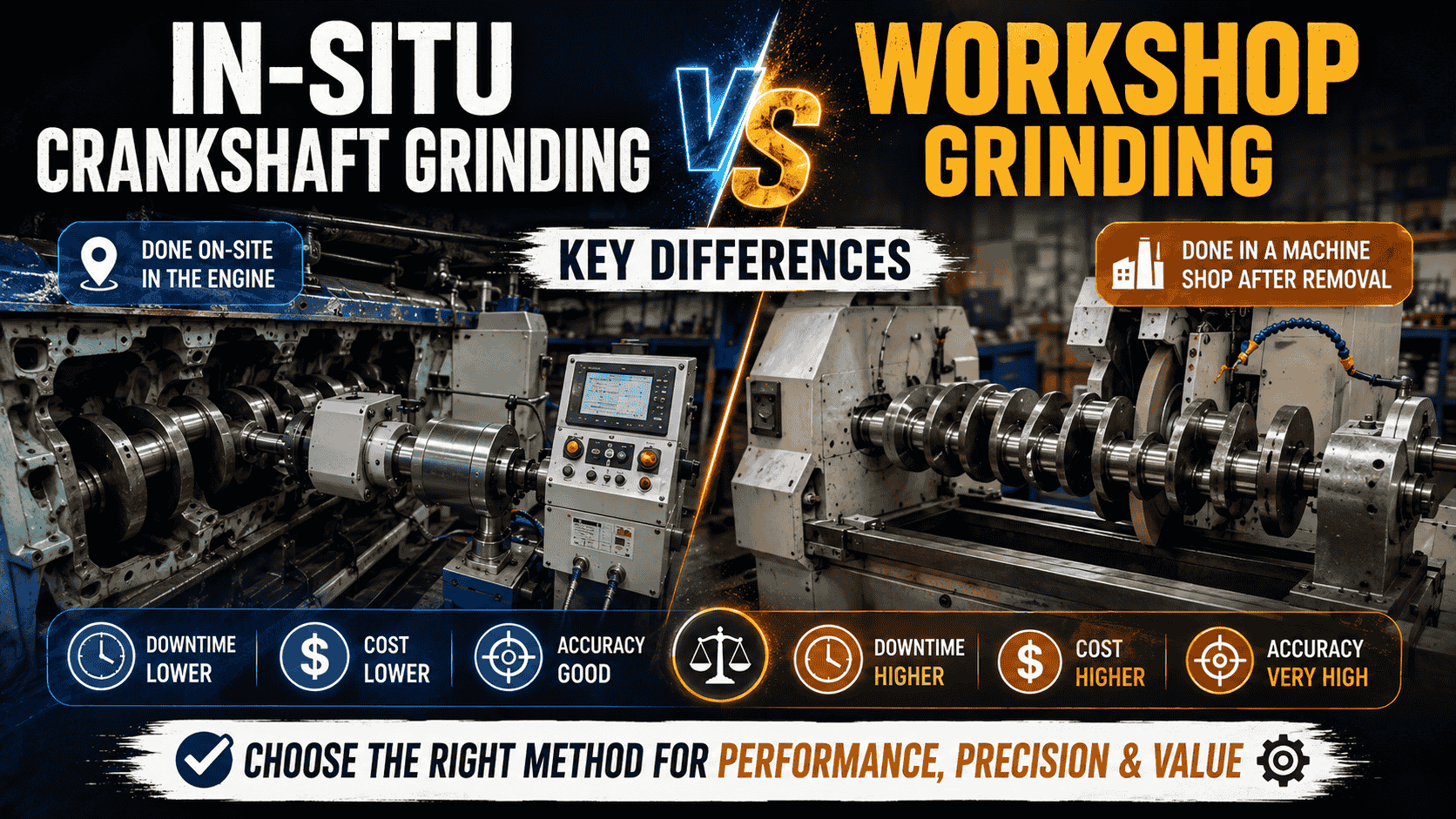
04 Jun In-situ Crankshaft Grinding vs Workshop Grinding: Key Differences
Introduction
Crankshaft grinding is one of the most essential parts of any engine because it converts the up-and-down motion of pistons into rotational motion, and it also allows the engine to operate smoothly and efficiently. Over time, the crankshaft surface becomes damaged due to continuous operation, no lubrication, and also due to excessive load; whenever this happens, polishing becomes necessary because it restores the crankshaft’s original dimensions and performance.
Nowadays, industries mainly have two options for repairing a crankshaft: In-situ crankshaft grinding and workshop grinding. Both methods are very much effective but it serves for different purposes depending on the engine size, engine condition, and operational requirement of the crankshaft.
From this blog, people can understand the differences between these two methods of repairing, their advantages, their limitations, and it also explains how to choose the right method of repairing for your engine.
What Is In-situ Crankshaft Grinding?
In-situ crankshaft grinding is the specialized repair process where the crankshaft remains in place and is not removed from the engine; instead of dismantling the entire engine and transporting the crankshaft to the workshop, engineers perform the grinding operation directly at the installation site.
This method uses advanced portable grinding machines that are installed directly into the crankshaft, and this equipment is designed to achieve precise grinding and polishing while the crankshaft remains in position.
Key Features of In-situ Grinding
- In situ grinding, we didn’t have to remove the crankshaft from the engine for repair.
- In this method, people use the portable and highly precise grinding equipment.
- It also reduces the engine maintenance period to a very large extent.
- From this method, the challenges that come with transportation are removed.
- This method is properly suitable for emergency repair situations.
Common Applications
In-situ crankshaft grinding is widely and frequently used in industries where engines are too big, heavy, and very difficult to dismantle, such as:
- This method of repair is used for marine engines and ships.
- Locomotives and railway engines also used this method for repairing the engines.
- In Diesel generator (DG) sets, this method is used for repairing the engines.
- This method of repair is used for repairing mining machines.
- In power plants, this method is used for repairing the engines.
- In industrial compressors, this method is used for repairing the engines.
What Is Workshop Crankshaft Grinding?
Workshop crankshaft grinding is the traditional repair method in which the crankshaft is completely removed from the engine and transported to a specialized workshop.
In the workshop, technicians use large stationary grinding machines that are specially designed for repairing the crankshaft. These machines are operated in a controlled environment with detailed measurements and are also inspected throughout the repair process.
Benefits of Workshop Grinding
- This method of repairing provides controlled working conditions.
- It provides complete inspection opportunities during the repair process.
- This method of repair is suitable for complete engine repair.
- This method of repair is effective for heavily damaged crankshafts.
Typical Applications
- Workshop grinding is generally used for small and medium-sized engines.
- This method of repair is used in vehicle engines.
- Those crankshafts that require complete repair.
- This method is used for repairing industrial engines if they get destroyed.
Key Differences: In-situ vs Workshop Grinding
Both methods, in situ and workshop grinding, are aimed at restoring the crankshaft performance, but there are significant differences in their approach and their benefits in restoring the performance of the crankshaft, which are given below:
| Factor | In-situ Grinding | Workshop Grinding |
| Location | This method is performed at the site. | This method is performed in a workshop. |
| Removal of Crankshaft | In this method of repair, removal of the crankshaft is not required. | In this method of repair, removal of the crankshaft is required. |
| Maintenance period | In this method of repair, the maintenance period is very low. | In this method of repair, the maintenance period is very high. |
| Transportation | In this method of repair, removal of the transportation is not required. | In this method of repair, removal of the transportation is required. |
| Cost | In this method of repair, the cost is very low for large engines. | In this method of repair, the cost is very high for large engines |
| Inspection Area | The inspection area is limited in this method of repair. | The inspection area is complete in this method of repair. |
| Suitability | The large engine’s suitable for this method of repairing. | The small to medium engines suitable for this method of repairing. |
| Accuracy | OEM-level with modern equipment is accurate. | The accuracy level is extremely precise in this method of repair. |
1. Maintenance Period
The maintenance period is one of the biggest factors when the time comes to choose a repair method.
In-situ crankshaft grinding, there is no need to dismantle the engine or transport the heavy components from one place to another, and from this method of repairing, engines can be repaired within a few days.
In the workshop grinding method, technicians have to dismantle the engine or transport the heavy components from one place to another, and in this method of repairing, engines can take time to get repaired.
- In the workshop, grinding repairing method engines have to be dismantled.
- Crankshaft removal is necessary in the workshop grinding and repairing method.
- Transportation is also required in the workshop grinding and repairing method.
- In the workshop, grinding and repairing engines are repaired in the workshop.
- In the workshop, grinding repairing method engines have to be reassembled.
2. Cost
In-situ crankshaft grinding is the cost-saving method because this method of repairing eliminates many expenses related to:
- In this grinding method, there is no need to lift the heavy equipment
- The in-situ crankshaft grinding method is an on-site grinding method, so there is no need for transportation, which removes the expenses related to transportation.
- In this grinding method, there is no need to dismantle the crankshaft because it is an on-site grinding method.
- In this grinding method, there is no need to reassemble because, in this method, we do not disassemble the crankshaft.
- In this grinding method, the maintenance period is very low, and due to this, the cost becomes very low.
3. Accuracy
In the past, the workshop grinding method was considered to be more accurate because this method of repair is performed in a controlled and favourable environment.
But nowadays, the in-situ crankshaft grinding method is considered more accurate due to modern portable grinding technology, and this method of grinding equipment can achieve OEM-grade tolerances and perfect surface finishes.
On the other hand, workshop grinding methods still offer slightly tighter control in some situations, and onsite repairs now provide more highly reliable and accurate results than workshop grinding methods for most industrial applications.
4. Engine Size Suitability
Engine size plays an important role in selecting the repair method because both of the grinding methods have their own benefits:
In-situ grinding is good for:
- Marine engines
- Large diesel engines
- Power generation units
- Mining machinery
Workshop grinding is more practical for:
- Small industrial engines
- Automotive engines
- Medium-sized machinery
5. Logistics and Transportation
Moving a large crankshaft is very difficult and expensive because there are many challenges included:
- Due to the movement of the crankshaft, technicians have to make the heavy lifting arrangements.
- To transport the crankshaft, technicians have to obtain transportation permits.
- Due to the transportation of crankshafts, technicians also have to face the risk of handling damage.
- Shipping delays are also a challenge due to the transportation of the crankshaft.
By using the in-situ crankshaft grinding service, these problems are completely removed because in this service of grinding, there is no need to transport the crankshaft. Repairing all happens at the customer’s location, which reduces both time and risk.
6. Inspection Opportunities
Workshop grinding offers some significant advantages when the crankshaft requires complete inspection. If the engine is completely dismantled, then technicians can inspect the crankshaft completely:
- Technicians are able to inspect the bearings.
- Connecting rods can also be inspected by technicians.
- Technicians are able to inspect the oil passages.
- Engine block components can also be inspected by technicians.
In-situ grinding method technicians are primarily focused on crankshaft repair and their related measurements; that’s why the workshop grinding method is mostly preferred when major issues are suspected.
When to Choose In-situ Grinding
There are many situations where In-situ crankshaft grinding is the best solution.
Choose this method when:
- Downtime must be minimized
- The engine is too large to dismantle easily
- The equipment is located in a remote area
- Damage is limited to crankshaft journals
- Immediate repair is required
- Transportation costs are high
Industries such as marine transportation, mining, and power generation frequently rely on on-site crankshaft grinding services because every hour of downtime can result in significant financial losses.
The ability to repair the crankshaft at the site allows operations to resume much faster while maintaining high-quality repair standards.
When to Choose Workshop Grinding
Workshop grinding remains an excellent option in specific situations.
It is often preferred when:
- The engine is undergoing a complete overhaul
- The crankshaft has severe structural damage
- Detailed inspection is required
- The engine is small or medium-sized
- Multiple engine components need repair
A workshop environment provides better access to all engine components and allows technicians to perform extensive diagnostics alongside crankshaft restoration.
When a full engine rebuild is planned, workshop grinding often becomes the most practical solution.
How MPA Power Project Helps
MPA Power Project provides professional crankshaft repair solutions tailored to different industrial requirements.
Our services include:
- In-situ crankshaft grinding
- Workshop crankshaft grinding
- Journal repair and restoration
- Crankshaft inspection and measurement
- Emergency repair support
Our trained engineers travel across India to deliver reliable onsite crankshaft grinding services at customer locations. Using modern portable grinding equipment and advanced measuring instruments, we achieve OEM-grade repair quality while minimizing downtime and operational disruptions.
Whether your engine requires onsite restoration or workshop reconditioning, our experienced team ensures dependable and cost-effective solutions.
Conclusion
Both in-situ and workshop crankshaft grinding methods play an important role in modern engine maintenance. The right choice depends on factors such as engine size, repair requirements, downtime considerations, and overall maintenance goals.
For large industrial engines where time is critical, In-situ crankshaft grinding offers significant advantages through faster repairs, lower costs, and reduced logistical challenges. On the other hand, workshop grinding remains valuable when complete engine overhauls and detailed inspections are necessary.
Before planning your next engine repair or overhaul, consult experienced professionals who can evaluate your specific situation. At MPA Power Project, we help industries choose the most effective crankshaft repair solution, ensuring maximum reliability, performance, and long-term engine life.
FAQs
1. Is in-situ crankshaft grinding as accurate as workshop grinding?
Yes. Modern portable grinding equipment can achieve OEM-level accuracy and surface finish, making in-situ grinding highly reliable for most industrial applications.
2. How much downtime does in-situ crankshaft grinding save?
In-situ grinding can reduce downtime by several days or even weeks because it eliminates dismantling, transportation, and reassembly processes.
3. Which method is more cost-effective for large engines?
For large engines, on-site crankshaft grinding services are usually more cost-effective because transportation and dismantling expenses are avoided.
4. Can in-situ grinding be done for any engine type?
It is most suitable for large marine, locomotive, power generation, and industrial engines. Suitability depends on engine design and damage condition.
5. Does MPA Power Project provide in-situ grinding pan-India?
Yes. MPA Power Project offers professional on-site crankshaft grinding and repair services across India through experienced field engineers and advanced portable equipment.Conclusion
Both in-situ and workshop crankshaft grinding methods play an important role in modern engine maintenance. The right choice depends on factors such as engine size, repair requirements, downtime considerations, and overall maintenance goals.
For large industrial engines where time is critical, In-situ crankshaft grinding offers significant advantages through faster repairs, lower costs, and reduced logistical challenges. On the other hand, workshop grinding remains valuable when complete engine overhauls and detailed inspections are necessary.
No Comments