



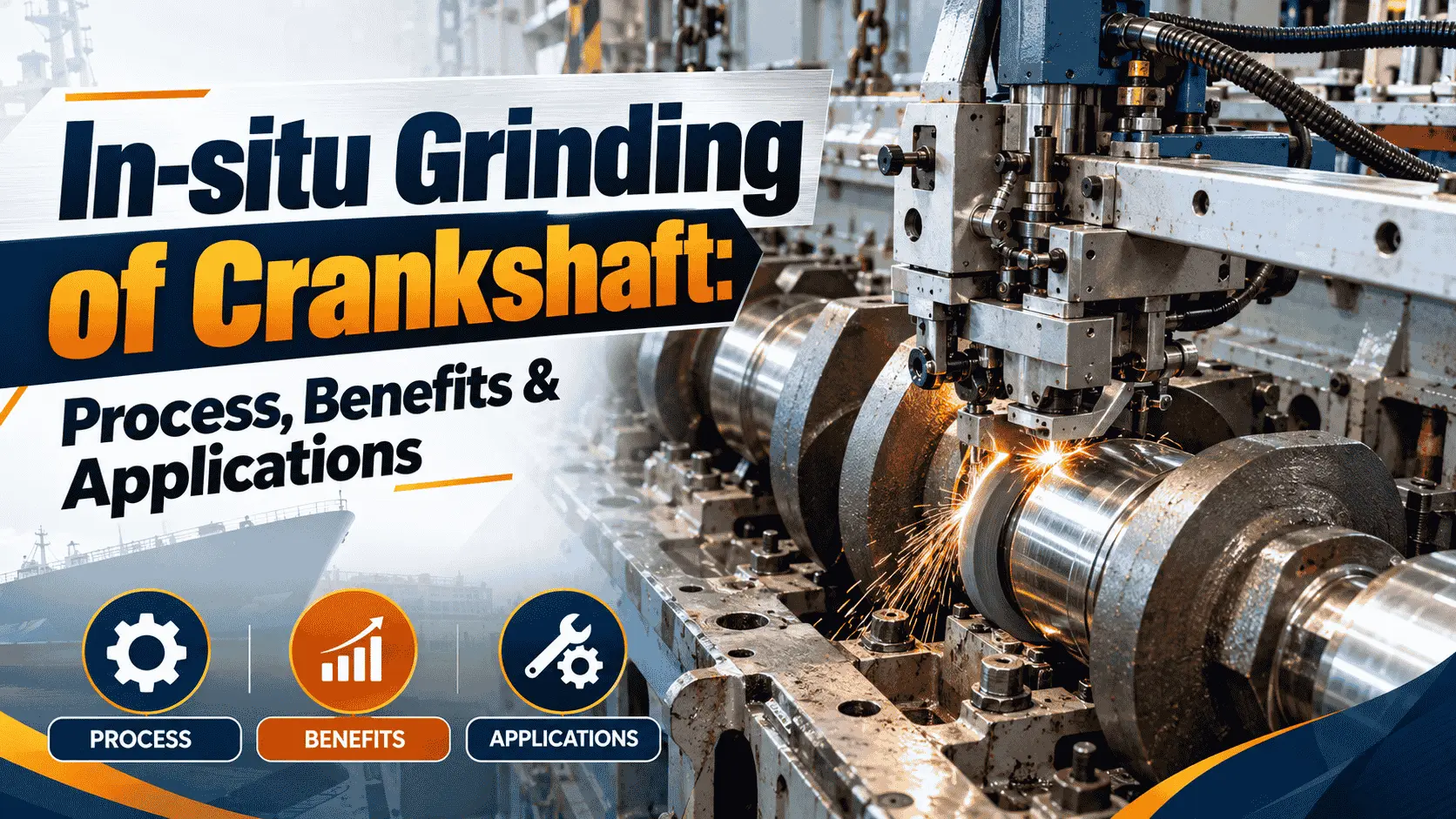
03 Oct In-situ Grinding of Crankshaft: Process, Benefits & Applications
A damaged crankshaft is one of the worst calls a plant manager or ship’s chief engineer can get. The engine stops. Production stops. On a vessel, the schedule slips and port charges start to climb. And the old way of fixing it — pull the engine apart, lift out the crankshaft, ship it to a workshop, wait, ship it back, rebuild — can take weeks.
There is a faster way. It is called in-situ grinding, and it means the crankshaft is repaired right where it sits, inside the engine.
Our engineers have been doing this work for over 15 years in engine rooms, power stations, steel mills, cement plants and offshore rigs. In this guide, we explain what in-situ crankshaft grinding is, how the process works step by step, the real benefits, where it is used, and when it may not be the right choice. We have kept the language simple so that maintenance heads, plant owners and ship superintendents can all use it.
What Is In-situ Grinding of a Crankshaft?
“In-situ” is a Latin term that simply means “in its original place.” So in-situ grinding of a crankshaft means grinding and polishing the damaged crankpins or main journals without removing the crankshaft from the engine block.
A portable grinding machine is clamped directly onto the crankshaft. The machine travels around the journal and removes a very thin layer of metal until the surface is round, smooth and back within the engine maker’s limits. The motion is usually driven by compressed air (pneumatic) or a chain mechanism. At MPA Power, our in-situ machines run on pneumatic compressed air, which works well in tight, hot engine rooms where electric drives can be a problem.
Why Do Crankshaft Journals Get Damaged?
Before we get into the process, it helps to know what we are usually fixing. From our site visits, the most common causes are:
- Lubrication failure – low oil pressure, a blocked oil line or dirty oil leads to metal-to-metal contact.
- Bearing failure – a seized or wiped bearing scores the journal surface. Very often, bearing rebabbitting or replacement is needed along with the grinding.
- Contaminated oil – water, fuel or tiny metal particles in the oil act like sandpaper.
- Overheating – heat can cause hard spots, colour change and even small cracks.
- Misalignment – uneven load wears the journal into an oval or tapered shape.
- Normal wear – after thousands of running hours, every journal wears a little.
Early signs usually include knocking sounds, rising vibration, dropping oil pressure and uneven bearing wear. If you see these, it is worth reading up on the common journal warning signs before the damage spreads.
The In-situ Crankshaft Grinding Process: Step by Step
Every job is a little different, but a typical in-situ grinding job follows the same basic path. Here is how our team handles it on site.
1. Site Survey and First Inspection
Our engineers first open up the crankcase and take a close look at the damaged journal. We check for scoring, heat marks, cracks and any sign of bending. We also ask the operators what happened before the failure — oil pressure readings, alarms, noises. This history often tells us as much as the measurements.
2. Measurements and Crack Detection
Using micrometers and dial gauges, we measure the journal diameter at several points to find out its ovality (how far out of round it is) and taper (how much thicker it is at one end). We also run hardness tests and crack detection, such as dye penetrant or magnetic particle testing. If the surface has become too hard from overheating, or if there is a deep crack, grinding alone may not be enough — and we tell the client this honestly at this stage.
3. Preparing the Work Area
The area around the journal is cleaned and protected. Oil holes are plugged and nearby parts are covered, so no grinding dust gets into the engine. This step is simple but very important. Skipping it is how small repairs turn into big ones.
4. Mounting and Aligning the Portable Machine
The portable grinding machine is clamped onto the crankshaft and carefully aligned with the journal. Good alignment decides the quality of the whole job, so our technicians take their time here.
5. Grinding in Controlled Passes
The machine removes metal in very small, controlled cuts. We check the size again and again as we go. The aim is to remove only as much metal as needed to clean up the damage and bring the journal to the next standard undersize given by the engine maker — never more.
6. Polishing and Surface Finishing
Once the journal is round and to size, it is polished to get a smooth surface finish. A smooth surface lets the new bearing form a proper oil film, which is what protects the journal in service.
7. Final Checks and Report
We take final readings for diameter, ovality, taper, hardness and surface finish, and hand over a written report. Where the vessel or plant is under class, our work follows the requirements of major classification bodies such as Lloyd’s Register and IRS, so the surveyor can review the results easily.
8. Bearing Fit and Engine Box-up
Correct undersize bearings are fitted, clearances are checked, the crankcase is closed and the engine is test-run under watch. Only after a smooth trial do we sign off.
Top Benefits of In-situ Crankshaft Grinding
1. Much Less Downtime
This is the biggest reason clients call us. There is no need to lift the engine, pull the crankshaft or send it anywhere. For a single damaged journal, the work is often finished in days, not weeks. For a ship waiting at port or a power plant with a running contract, that time saving is worth a lot.
2. Lower Total Repair Cost
You save on dismantling labour, crane hire, transport, workshop charges and re-assembly. You also avoid buying a new crankshaft, which for large marine and industrial engines can be very expensive and may have long delivery times.
3. Less Risk to Other Engine Parts
Every time a large engine is fully stripped and rebuilt, there is a chance of new problems — damaged seals, misalignment, parts put back wrongly. Keeping the crankshaft in place avoids most of that risk.
4. Accuracy That Matches Workshop Work
Modern portable grinders, in trained hands, can bring journals back within the engine maker’s limits for roundness, taper and finish. Done properly, the result is as good as a workshop job.
5. Works Where Removal Is Hard or Impossible
On many ships and in older plants, taking out the crankshaft means cutting through the deck or opening walls. In-situ grinding removes that headache completely.
6. Longer Life for Your Existing Engine
A well-repaired crankshaft can run for many more years. This lets owners get full value from an engine instead of replacing it early.
Where Is In-situ Crankshaft Grinding Used?
Any large engine where removal is costly or slow is a good candidate. The main areas we work in are:
- Marine – main engines, auxiliary engines and emergency generators on cargo ships, tankers, naval and merchant vessels, both at sea and in dry dock.
- Offshore oil & gas – engines and compressors on rigs, where space is tight and every hour of downtime is costly.
- Power generation – diesel and gas generator sets in power stations and captive power plants.
- Steel mills and cement plants – large standby and process engines that run round the clock.
- Mining – heavy engines working in remote sites where transport is slow.
- Refineries and factories – compressors and generator sets that support continuous production.
We regularly work on engines from makers such as MAN B&W, Wärtsilä, Caterpillar, Cummins and Volvo Penta. The same in-situ approach also works for turbine, rotor and alternator shafts, which is why many clients use us for turbine rotor grinding as well.
When In-situ Grinding May Not Be the Right Choice
Honest advice matters more than winning a job. In-situ grinding is not a fix for everything. It may not be suitable when:
- The crankshaft has a deep crack or has broken.
- The journal is already at, or near, the last allowed undersize.
- The shaft is badly bent beyond what can be corrected.
- Heat damage has made the surface too hard, too deep to grind out safely.
In these cases, a new or reconditioned crankshaft may be the better long-term decision. If you are unsure, this guide on whether to repair or replace a crankshaft explains the key points to weigh.
Tips to Get the Best Result From an In-situ Job
- Call early. A lightly scored journal needs far less grinding than one that has run on a failed bearing for hours.
- Share the engine history. Running hours, past undersizes and recent alarms help the engineer plan better.
- Keep the engine maker’s manual ready. It lists the allowed undersizes and clearances.
- Fix the root cause. If the oil system caused the failure, clean and repair it too, or the new surface will be damaged again.
- Ask for a written report. It is useful for class surveys, insurance and future maintenance.
Why Choose MPA Power Projects for In-situ Crankshaft Grinding?
- 15+ years of field experience on land-based plants, offshore rigs and sea-going vessels, in India and overseas.
- 24×7 availability – our engineers travel at short notice with portable tooling.
- In-house testing facility for crack detection, hardness checks, shaft trueness and bearing white metalling.
- Work to class standards – our jobs follow the requirements of Lloyd’s Register, IRS and other inspecting agencies.
- One team for related work – line boring, bearing rebabbitting, metal locking and complete engine overhauls.
If you have a crankshaft problem right now, you can learn more about our in-situ crankshaft grinding service or call our team directly for a site assessment.
Frequently Asked Questions
1. How long does in-situ crankshaft grinding take?
It depends on the engine size, the number of damaged journals and how deep the damage is. A single journal on a medium-sized engine is often done within a few days. Larger marine engines with several damaged crankpins can take longer. We give a time estimate after the first inspection.
2. Is in-situ grinding as accurate as workshop grinding?
Yes, when it is done with the right equipment and by trained technicians. Modern portable machines can bring the journal back within the engine maker’s limits for roundness, taper and surface finish. Final readings are recorded and shared with you.
3. How much metal is removed during grinding?
Only as much as needed to remove the damage. The journal is ground to the next standard undersize listed by the engine maker, and matching undersize bearings are then fitted. We never grind beyond the allowed limits.
4. Can in-situ grinding be done on a ship at sea?
Yes. Our engineers regularly work on vessels at sea, at anchor and in dry dock. The equipment is portable and designed to work in tight engine room spaces.
5. What should I do if I suspect crankshaft damage?
Stop the engine if it is safe to do so, note down oil pressure, temperatures and any alarms, and avoid running it further. Then get a qualified team to inspect it. Early action usually means less grinding, lower cost and a longer life for the crankshaft.
Final Thoughts
In-situ grinding has changed how crankshaft damage is handled. Instead of weeks of downtime and heavy costs, most journal problems can now be fixed on site, quickly and accurately. The key is to act early, work with an experienced team, and deal with the root cause of the failure.
If your engine is showing signs of crankshaft trouble, talk to MPA Power Projects. Call +91 98112 82433 or email info@mpapowerproject.in — our engineers are available round the clock.
No Comments