



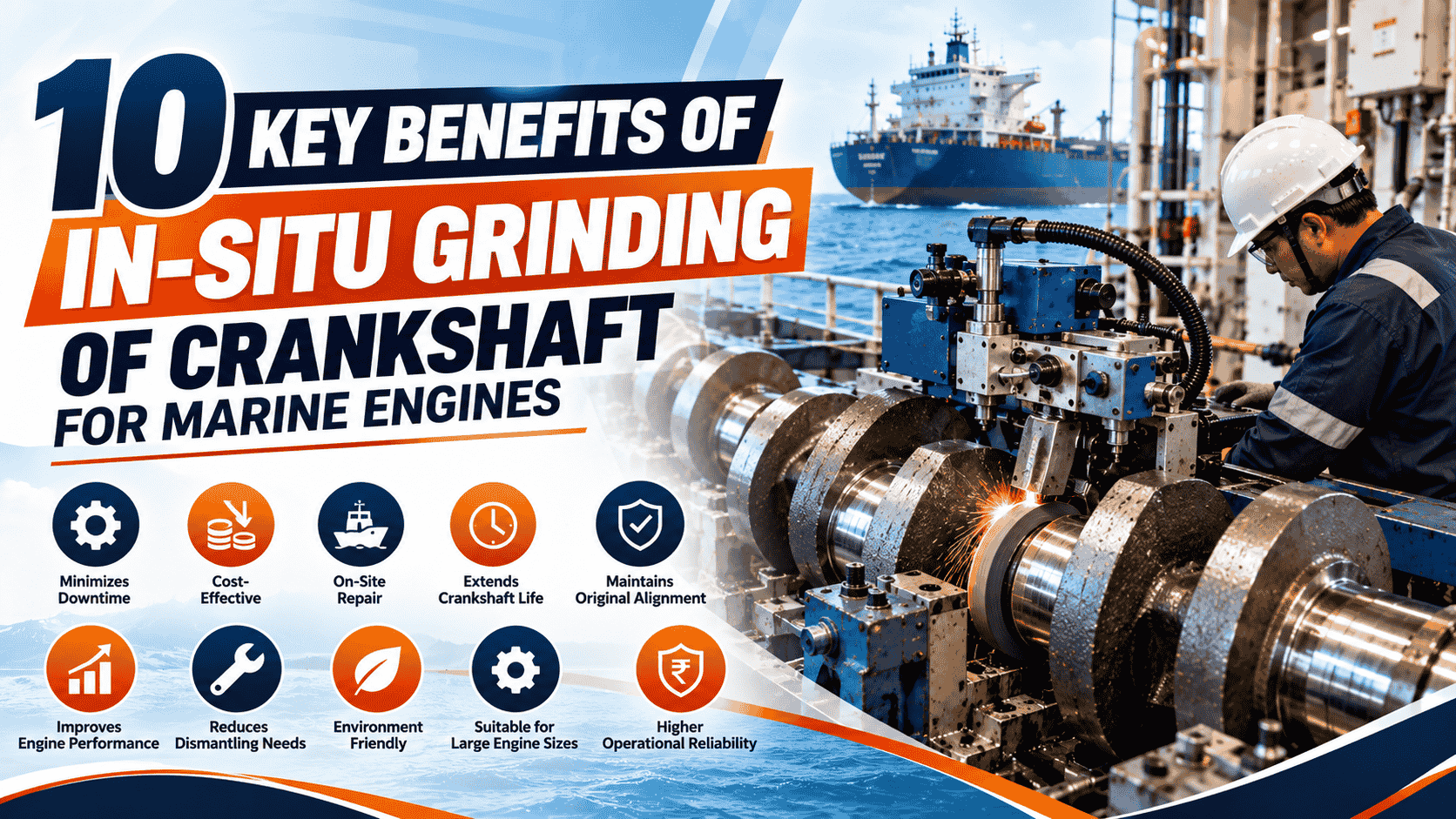
17 Oct 10 Key Benefits of In-Situ Grinding of Crankshaft for Marine Engines
When a crankshaft journal gets scored, oval or worn on a ship, the first question every chief engineer asks is simple: “How long will the vessel be stuck?” The second question comes right after: “How much is this going to cost us?”
For a long time, the answer was painful. The crankshaft had to be lifted out of the engine, shipped to a workshop, ground on a big lathe and then sent back. Sometimes the hull or deck had to be opened just to get it out. That meant weeks of off-hire time, a big crane bill and a lot of risk.
In-situ grinding changed that. In simple words, “in-situ” means “in its place.” Our technicians bring a portable grinding machine on board, clamp it directly on the damaged journal and machine it back to the right shape and finish while the crankshaft stays inside the engine.
Over the last 15 years, our team has done this work in engine rooms, on offshore units and at power plants. Below, we share the 10 benefits we see again and again on real jobs, explained in plain language, so you can decide if this repair is right for your vessel.
What Is In-Situ Crankshaft Grinding?
Before the list, a quick picture of the job. The engine is opened, the main or crankpin bearing is removed, and the journal is cleaned and measured. We check for ovality, taper, scoring, cracks and hardness. Then a light, portable grinding (or machining) unit is mounted on the journal. It turns around the pin and removes a very small amount of metal until the journal is round, straight and smooth again.
After grinding, the journal is polished, measured again and tested for cracks. If the journal size has come down, matching undersize bearings are fitted. Then the engine is boxed up and run.
That is the whole idea. Now let us look at why it makes such a big difference for marine engines.
1. It Cuts Engine Downtime by a Huge Margin
For a ship, time really is money. Every day a vessel sits idle means lost charter income, port fees and unhappy cargo owners.
Taking a crankshaft out of a large marine engine is a long job. You need to remove the cylinder heads, pistons, connecting rods and often parts of the engine frame. After that comes lifting, transport, workshop time and then putting it all back together.
With in-situ grinding, most of these steps are simply gone. The crankshaft never leaves the engine. In many cases, a journal that would need weeks of off-site work can be ground on board in a matter of days. For a ship owner, that can be the difference between missing a charter and sailing on time.
2. No Need to Lift the Crankshaft or Cut Open the Hull
On many vessels, the engine room was built around the engine. There is no easy way to pull out a long, heavy crankshaft. Removing it can mean cutting openings in decks or the hull, hiring a heavy crane and sometimes going into dry dock.
In-situ grinding avoids all of this. The machine is small enough to be carried into the engine room in parts and assembled right next to the crankshaft. No steel cutting, no welding the hull back together and no extra class survey for structural work.
This is one of the main reasons the industry has moved towards on-site repair. We have written about this shift in detail in our article on the in-situ services trend.
3. It Costs Much Less Than a New Crankshaft
A new crankshaft for a large two-stroke or medium-speed four-stroke engine is one of the most expensive spare parts on a ship. Add freight, installation and the long off-hire period, and the total bill can be very high.
In-situ grinding fixes the part you already own. You pay for the technicians, the machine and the inspection, not for a brand-new forged shaft. In most cases where the damage is limited to journal surfaces, grinding is the far cheaper option.
Of course, not every crankshaft can be saved. If you are unsure, our guide on whether to repair or replace a crankshaft explains the key checks we use to make that call.
4. You Avoid Long Waiting Times for Spare Parts
Even if money is not the problem, time often is. New crankshafts are not usually sitting on a shelf. They are forged and machined to order, and lead times can run into months for some engine models. Older engines may not have easy spare support at all.
When you choose in-situ grinding, you are not waiting on a factory. Our team can be mobilised quickly, and the repair starts as soon as we reach the vessel. For older ships where OEM parts are hard to find, this can be the only practical way to keep the engine running.
5. The Work Can Be Done Almost Anywhere
Ships do not always break down near a big repair yard. A bearing failure can happen mid-voyage, at a remote port or on an offshore platform.
Because the grinding equipment is portable, the repair can be done at the berth, at anchorage and in many cases at an offshore location. We work round the clock, seven days a week, and travel to vessels across the world. The repair comes to the ship, not the other way around.
This flexibility is a big part of modern marine engine repair, where owners want fast fixes with the least disturbance to their trading plans.
6. It Brings Journals Back to Tight Tolerances
A common worry we hear is: “Can a portable machine really be as accurate as a big workshop lathe?” The honest answer is yes, when it is done by trained hands with the right tools.
Modern in-situ grinding machines are built to bring journals back within the engine maker’s limits for ovality, taper and surface finish. During the job, our technicians take readings again and again with micrometers and other precision gauges. We do not move on until the journal is round, straight and smooth enough for the bearing to run safely.
A good surface finish matters a lot. A rough journal can wipe the new bearing within hours. A properly finished one gives the oil film a smooth surface to ride on, which protects both the shaft and the bearing.
7. Less Risk of Extra Damage From Handling
Every time a heavy part is lifted, moved and lowered, there is a chance of something going wrong. A crankshaft can bend if it is supported the wrong way. It can get knocked during transport. Fitting it back in the engine also needs careful alignment work.
When the crankshaft stays in its own bearings, these risks drop sharply. The shaft stays supported the way it was designed to be. The engine’s alignment is not disturbed as much as it would be in a full removal. Fewer moving parts in the job means fewer chances for new problems.
8. You Get a Full Health Check of the Crankshaft
In-situ grinding is not just about machining. A good job always starts and ends with inspection. Before grinding, we check the journal for:
- Ovality and taper, using precise diameter readings
- Scoring, pitting and heat marks
- Surface cracks, using crack detection methods like magnetic particle or dye penetrant testing
- Surface hardness, to see if heat from a bearing failure has softened the metal
This gives the owner a clear picture of the crankshaft’s health, not just a quick fix. Sometimes we find small cracks or hard spots that would have caused a bigger failure later. If you want to know the warning signs to look for in the first place, our post on crankshaft damage covers them in detail.
9. It Makes Class Approval Simpler
Repairs on a ship’s main or auxiliary engine often need to be accepted by the classification society. The surveyor will want to see the damage, the repair method and the final measurements.
With in-situ grinding, the surveyor can attend on board and see the work while it happens. All readings before and after the job are recorded in a clear report. This makes it easier for the owner to close the class item and get the ship back to trading without long paperwork delays.
At MPA Power Project, we share a full repair report at the end of every job, with measurements, photos and inspection results, so nothing is left as guesswork.
10. It Helps Your Engine Last Longer
The final benefit is the one that matters most over time. A crankshaft with worn or oval journals will keep destroying bearings. It can also lead to higher vibration, oil problems and, in the worst case, a seized engine.
Grinding the journals back to good shape, and fitting the right bearings, gives the engine a fresh start. When it is done as part of a planned engine overhaul, it can add many more running hours to the crankshaft and the engine as a whole.
Pair it with good oil care, regular bearing checks and routine engine maintenance, and your crankshaft can keep working reliably for years.
When Should You Consider In-Situ Grinding?
From our experience, you should talk to an in-situ machining team when you notice any of these:
- A main or crankpin bearing has failed or shows heavy wear
- Scoring or heat marks are visible on the journal after opening up
- Bearing clearances are going out of limits faster than normal
- Crankshaft deflection readings or oil analysis point to bearing trouble
- Rising vibration or knocking sounds from the engine bottom end
The sooner the damage is caught, the less metal needs to be removed and the more life the crankshaft keeps. Small problems are quick to fix. Big ones get expensive fast.
Also, keep in mind that the bearings matter as much as the shaft. If the white metal on your bearings is damaged, bearing rebabbitting can often bring them back instead of buying new ones.
How to Choose the Right In-Situ Grinding Partner
Not every team that owns a portable grinding machine can deliver a lasting result. Here is what we suggest you look for:
- Real marine experience: Ask how many crankshaft jobs they have done on engines like yours.
- Proper inspection: The team should test for cracks and hardness, not just grind and leave.
- Clear reporting: You should get before and after readings, photos and a written report.
- Fast response: A good partner can reach your vessel quickly, wherever it is.
- Honest advice: If the shaft cannot be saved, they should tell you plainly.
Final Thoughts
In-situ crankshaft grinding has become one of the smartest repair choices for marine engines. It saves time, saves money and saves the original crankshaft. It also cuts the risk and hassle of removing heavy parts from a tight engine room.
For ship owners, technical superintendents and chief engineers, the main point is simple: when a crankshaft journal is damaged, do not jump straight to replacement. Get it inspected first. In many cases, an on-board repair can put your engine back in service in days, not months.
At MPA Power Project, our in-situ machining team is ready 24/7 to help vessels and plants around the world. If your engine has a crankshaft problem, reach out to us with the engine make, model and the damage details, and we will guide you on the best way forward.
Frequently Asked Questions
1. What is in-situ grinding of a crankshaft?
In-situ grinding is a repair method where the crankshaft journals are ground and polished while the crankshaft stays inside the engine. A portable grinding machine is fixed on the damaged journal, and it removes a thin layer of metal to bring the journal back to the correct shape, size and finish.
2. How long does in-situ crankshaft grinding take on a marine engine?
It depends on the engine size, the number of journals damaged and how deep the damage is. A single journal with light scoring can often be done in a day or two. Larger jobs with several damaged journals take longer. In almost all cases, it is much faster than removing the crankshaft and sending it to a workshop.
3. Is in-situ grinding as accurate as workshop grinding?
Yes, when done by an experienced team. Modern portable machines can bring journals back within the engine maker’s limits for ovality, taper and surface finish. Each journal is measured many times during the job to confirm the result before the engine is boxed up.
4. Will I need undersize bearings after grinding?
Usually, yes. Grinding removes a small amount of metal, so the journal becomes slightly smaller. Matching undersize bearings are then fitted to keep the correct oil clearance. The exact undersize depends on how much material had to be removed and the steps allowed by the engine maker.
5. Can every damaged crankshaft be repaired by in-situ grinding?
No. If the crankshaft has deep cracks, is badly bent, or the journal has already been ground close to its minimum allowed size, replacement may be the safer choice. That is why a proper inspection with crack testing and hardness checks is always done first. A good repair team will tell you honestly if grinding is not the right option.
No Comments