



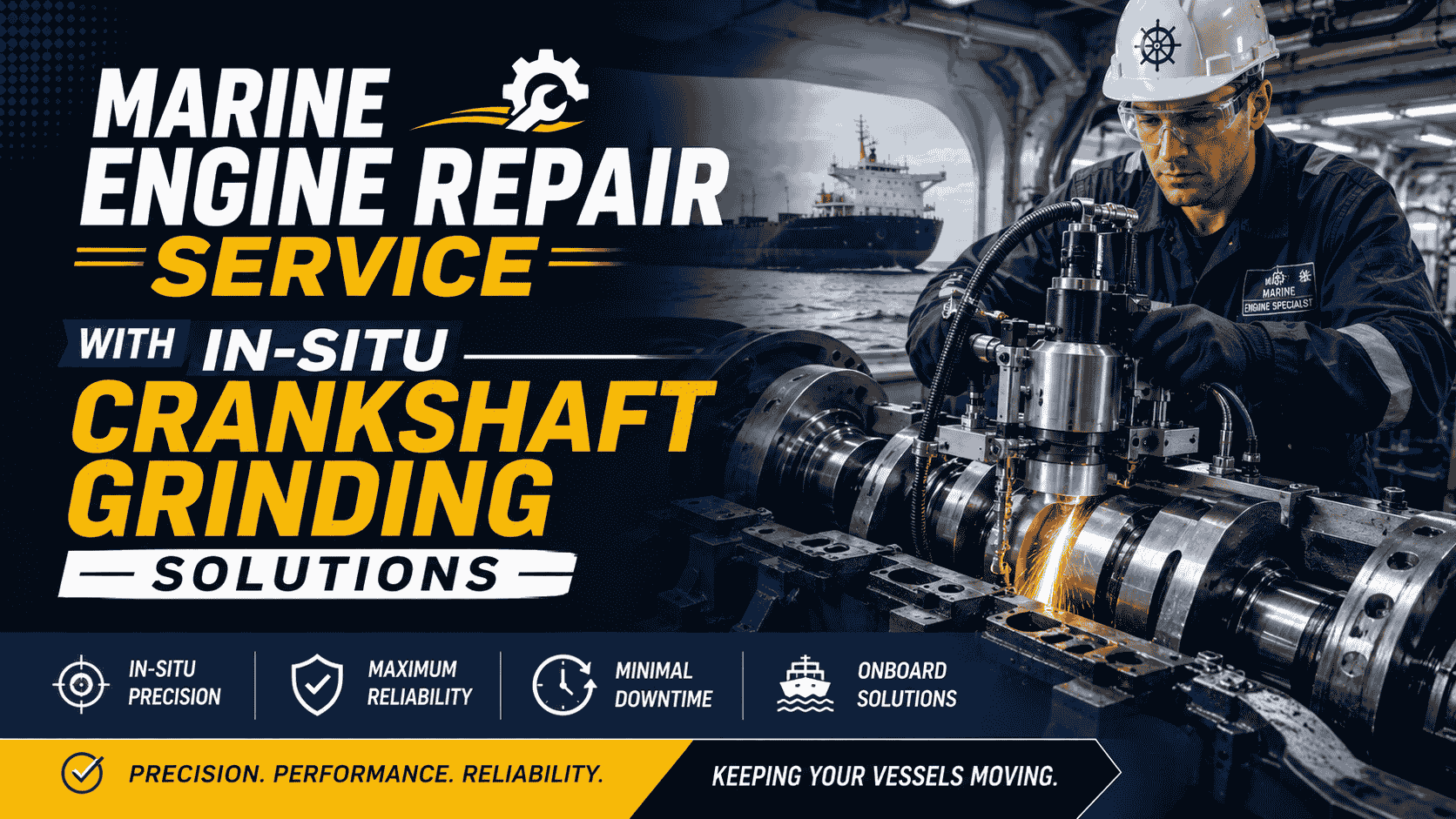
07 May Marine Engine Repair Service with In-situ Crankshaft Grinding Solutions
Engine failures in marine engines is a very common issue and this causes heavy losses and shutdown for days. This is because the traditional repair process takes apart the engine, ships its components to the facility. This requires a longer time period and high costs. For heavy repair, this is okay but industries can’t follow this for every minor damage.
Doing so will result in big financial losses very often. The in-situ grinding solution offers an alternate solution to repair the components at the units itself. Plus, you don’t need to disassemble the parts as well.
In this blog, we will explore the In-situ grinding solutions and how it can help you with on-site marine engine repair services.
What Is In-Situ Crankshaft Grinding and How Does It Work?
In-situ crankshaft grinding is an advanced repairing technique that repairs your marine engines in the marine industry. It allows the technicians to repair the engine and the vessel without disassembling the machine.
This process uses portable machinery and offers a precise and proper finish. The overall process requires:
- Checking for cracks.
- Assessing wear
- Verifying proper alignment
After these, the engineer sets up a complete repair process with controlled grinding. This creates a smooth surface shape and finish to the project.
At last, the final testing confirms the standard compliance by taking measurements to check all the tolerance against all the established standards.
Common Crankshaft Problems Found in Marine Engines:
Here are the common crankshaft problems found in marine engines:
- Wear & Tear:
The surfaces of a marine engine deteriorate due to continuous operation and friction.
- Cracks:
Sometimes, you may put an immense load on Marine engines. Furthermore, extreme temperatures may often create cracks within the crankshaft.
- Misalignment:
Sometimes, you can see some misalignments in the shaft too. This leads to vibrations within the engine and increases the damage chances.
Why Traditional Crankshaft Repair Methods Fall Short for Marine Vessels?
Here are the reasons why traditional crankshaft repair methods fall short for marine vessels:
- Requires engine removal, increasing downtime
- High logistics and transportation cost
- Risk of damage during disassembly and transit
- Not suitable for emergency or offshore repairs
- Delays vessel operations and project timelines
- Requires dry docking in most cases
- Limited flexibility for on-site repair needs
Key Benefits of In-Situ Crankshaft Grinding for Marine Engine Repair:
In-situ crankshaft grinding ensures the continued operational efficiency of ships. Here are the key benefits of In-situ Crankshaft Grinding you should know:
- Cost Savings
Previously, the process of dismantling, transporting, and reassembling an engine incurred extremely high costs. Now, with the use of in-situ crankshaft grinding, repair costs have been drastically reduced.
- Reduced Downtime
Engine repairs used to require multiple weeks of work can now be completed within a few hours. It enables the vessel to operate continuously without extended periods of downtime.
- High Precision
The current machinery provides micron-level precision which enables restoration of the crankshaft to its original size. It effectively restores the system to its original operational state while improving its functionality.
- Suitable for Large Engines
Marine engines are typically massive in size, making them difficult to move. In-situ crankshaft grinding is ideally suited for such large and heavy machinery, as it eliminates the need to transport the engine from one location to another.
Types of Marine Engines We Service with In-Situ Crankshaft Grinding:
Here are the different types of marine engines:
- Two-Stroke Marine Engines
The engines operate on two-stroke cycles. They produce power for large ships which require exact grinding because they work under maximum load conditions throughout their operational period.
- Four-Stroke Marine Engines
The engines which operate on four-stroke cycles function in smaller boats, which need regular upkeep to maintain their operational efficiency and fuel consumption efficiency.
- Diesel Generator Engines
The engines generate power for the ship. They receive immediate repairs because their breakdown leads to operational interruption.
- Auxiliary Engines
The engines provide auxiliary power to ships. They function reliably, which makes it necessary to repair them through in-field maintenance work.
- High-Speed Engines
The engines power patrol boats and ferries. They require operational reliability because even short service interruptions lead to operational problems.
Our Step-by-Step Marine Engine Repair Process:
Here are the steps we follow in marine engine repair process to deliver a structured and precise results with safety:
- Inspection and Diagnosis
We evaluate crankshaft condition through advanced tools which detect wear patterns and cracks and alignment problems.
- On-Site Setup
The team sets up specialized portable grinding equipment, which they use to grind engine components without engine disassembly.
- Measurement and Quality Check
The grinding process requires continuous monitoring to maintain precise control over both dimension measurements and surface finish results.
- Polishing and Finishing
The polishing process establishes a protective barrier which extends equipment endurance by reducing friction to sustain operational efficiency throughout extended use.
- Testing and Validation
The testing process evaluates engine performance after repairs to determine both operational reliability and compliance with industry standards.
Industries and Vessels That Rely on Our Marine Engine Repair Services:
Here are the industries and vessels that rely on our Marine engine repair services:
- Cargo ships and bulk carriers
- Oil and gas vessels
- Naval and defence vessels
- Fishing boats and trawlers
- Tugboats and harbour vessels
- Power generation ships
- Marine transport and logistics companies
Why Choose Us for Marine Engine Repair and In-Situ Crankshaft Grinding?
As a trusted name in the industry, our team offers you peak performance, dependable operations, while conserving fuel too. Our Marine Engine Repair Service stands out because of our engineer’s expertise, advanced technology and our dedication to delivering superior service with modern equipment, and precise results.
Here is what we offer:
- Rapid service
- Budget-friendly
- On-site services
This decreases equipment downtime and financial losses for our clients.
Key Specialities:
- Advanced portable grinding machines
- Reduced downtime and cost savings
- High accuracy and quality assurance
- Global service availability
- Quick response for emergency repairs
Conclusion:
In-situ crankshaft grinding repairs marine engines. It reduces expenses, and engine downtime. The process maintains engine performance. It handles large engine operations most effectively. You need to start fixing your engine problems immediately instead of waiting until they become bigger.
The marine industry currently requires more in-situ crankshaft grinding services than before. The in-situ crankshaft grinding is a smart and effective alternative which allows us to conduct engine repairs at their current location without needing to take engines out.
FAQs:
- What is in-situ crankshaft grinding and why is it preferred over traditional methods?
The In-situ crankshaft grinding repair process works directly on the engine. It lets you operate with improved speed while decreasing both your operational costs and their inactive periods.
- How long does an in-situ crankshaft grinding service typically take for a marine engine?
In-situ crankshaft grinding takes a few hours to two days. However, it depends on engine dimensions but it always provides speedy results than conventional workshop methods.
- Can in-situ crankshaft grinding be performed on all types and sizes of marine engines?
Yes, in-situ crankshaft grinding can be performed on all types and sizes of marine engine. This requires access points to evaluate engine damage.
- How do I know if my marine engine’s crankshaft needs grinding or a full replacement?
The engine shows scoring or misalignment. The determination of which method to use rests with the experts who evaluate the situation.
- Is the vessel required to be drydocked during the in-situ crankshaft grinding process?
No. There is no requirement of the vessel to be drydocked during the in-situ crankshaft grinding process.
No Comments