



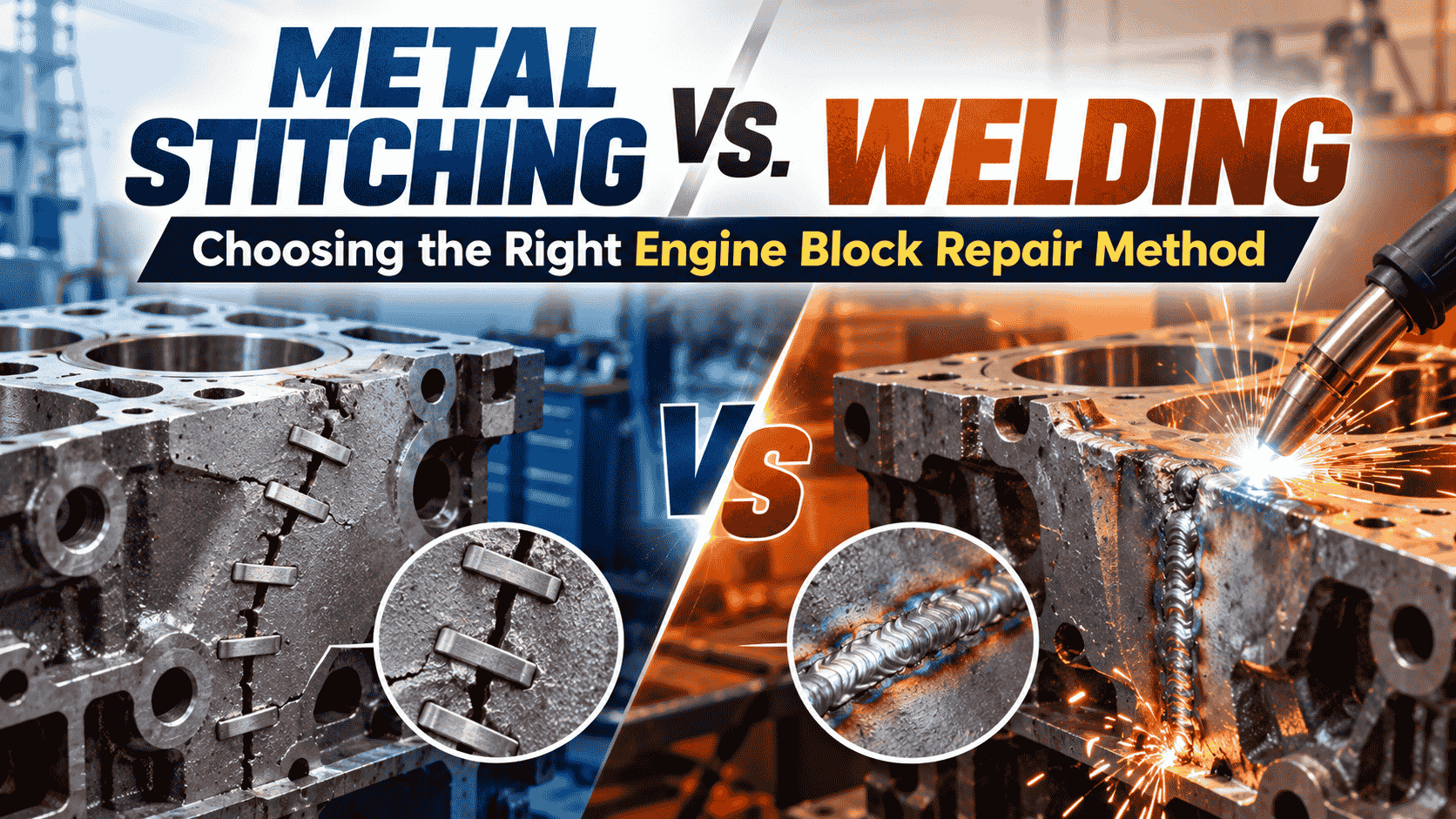
26 Oct Metal Stitching vs. Welding: Choosing the Right Engine Block Repair Method
A cracked engine block is a serious problem for any plant manager, ship engineer or fleet owner. A replacement block may take weeks to arrive, and every hour of downtime costs money. So the first question is simple: can it be repaired, and how?
In most cases the answer comes down to two methods. This guide on Metal Stitching vs. Welding explains how each one works, where each performs well, and how to pick the right one for your engine. It is written from the experience of technicians who repair cast iron engine blocks and housings on site.
Why Engine Blocks Crack in the First Place
Most large engine blocks used in power plants, ships, locomotives and heavy industry are made of grey cast iron. Cast iron is strong under compression, absorbs vibration well and is cheap to cast into complex shapes. Its weakness is that it is brittle. It contains roughly 2.5 to 4 percent carbon, much of it in the form of graphite flakes, and it does not stretch much before it breaks.
Common causes of cracks include:
- Freezing of coolant in the water jacket during cold weather or long shutdowns
- Overheating caused by a failed cooling system, followed by sudden cooling
- Thermal stress from repeated start and stop cycles
- Mechanical damage, such as a broken connecting rod punching through the block
- Old casting defects that grow over years of vibration
Before choosing any repair, the crack has to be inspected properly. Technicians use dye penetrant testing or magnetic particle testing to find the full length of the crack, including the fine ends that are not visible to the eye. If you want to understand the inspection side in more detail, our guide on repairing engine block cracks covers it step by step.
How Welding Repairs a Cracked Engine Block
Welding joins metal by melting the base material and a filler rod together. On steel, this is routine. On cast iron, it is much harder, because of how the material reacts to heat.
There are two main approaches to welding cast iron:
- Hot welding: the whole casting is preheated, usually to somewhere between 500 and 650 degrees Celsius, then welded and cooled very slowly in a furnace or insulated blanket. This reduces the risk of new cracks, but it needs the block removed from the engine and placed in controlled conditions.
- Cold welding: short weld runs are made with nickel based rods while the casting is kept relatively cool. Each run is peened (lightly hammered) to relieve stress. It avoids full preheating, but the results depend heavily on the welder’s skill.
Where welding falls short on cast iron
The main problem is the heat affected zone, the area next to the weld that gets hot but does not melt. In cast iron, rapid cooling of this zone can form hard, brittle structures. These areas often crack again, sometimes right next to the original repair, a few weeks after the engine is back in service.
Welding heat can also distort the block. Even a small amount of warping can throw off cylinder bores, main bearing housings and deck surfaces, which then need machining. In a large marine or power plant engine, that can turn a crack repair into a much bigger job.
Where welding still makes sense
Welding works well on cast steel and ductile iron parts, on small components that can be preheated in a workshop furnace, and on areas that need new material built up rather than a crack closed.
How Metal Stitching Repairs a Cracked Engine Block
Metal stitching is a cold repair process. No melting, no high heat, and no change to the structure of the cast iron. Instead, the crack is closed and locked mechanically, using special inserts that are installed across and along it.
A typical metal stitching repair follows these steps:
- Crack mapping: the full length of the crack is found with dye penetrant testing, and the ends are drilled to stop the crack from travelling further.
- Stitching pins: holes are drilled and tapped along the crack line, and threaded stitching pins are screwed in so that each one overlaps the next. This seals the crack against oil, water and gas leaks.
- Locks: slots are drilled across the crack and high strength alloy locks (also called keys) are driven in. These pull the two sides of the crack together and carry the tensile load across the repair.
- Peening and finishing: the pins and locks are peened into the parent metal so they form a tight bond, then the surface is ground flush. A pressure test confirms that the repair is leak proof.
Our article on metal locking and stitching techniques explains the difference between pins and locks in more depth, with examples of where each is used.
Why metal stitching suits cast iron
Because the process stays cold, there is no heat affected zone and no risk of creating brittle areas around the crack. The block does not distort, so bores and bearing lines stay where they were. And because the work is done with portable drilling and tapping equipment, it can usually be carried out with the block still in the engine, inside the ship’s engine room or the plant’s generator hall.
Metal Stitching vs. Welding: Side-by-Side Comparison
Here is a practical comparison of the two methods for cast iron engine block repair:
| Factor | Metal Stitching | Welding |
| Heat applied | None (cold process) | High, often with preheating |
| Risk of new cracks | Very low | Moderate to high on grey cast iron |
| Distortion of the block | None | Possible, may need re-machining |
| Can be done on site | Yes, in most cases | Hot welding usually needs workshop and furnace |
| Engine dismantling | Minimal | Often the block has to be removed |
| Pressure tightness | Leak-proof when pins overlap correctly | Depends on weld quality; porosity is common in cast iron |
| Best suited for | Grey cast iron blocks, heads, housings, large castings | Steel, ductile iron, small removable parts, build-up work |
| Downtime | Usually shorter | Longer, due to preheating, slow cooling and machining |
How to Choose the Right Method for Your Engine
The right choice depends on your engine, the damage and your operating situation. Ask these questions before you decide:
What material is the part made of?
If it is grey cast iron, metal stitching is usually the safer option. If it is steel or ductile iron, welding may be a good fit. If you are not sure, a technician can check the material with a simple spark or chip test, or by looking at the casting marks.
Where is the crack?
Cracks in water jackets, between cylinder bores, on the side walls or near bearing housings respond well to stitching. Cracks that pass through a highly stressed area, such as a main bearing saddle, need careful engineering whichever method you use, and sometimes the saddle needs machining afterwards. In such cases, line boring and repair work is often done along with the crack repair to restore alignment.
Can the engine be removed?
Lifting the block out of a large marine or stationary engine can take days, cranes and a full shutdown. If the block has to stay in place, metal stitching is the practical answer, since hot welding cannot be done properly inside an engine room. It also avoids preheating and re-machining, so the engine usually returns to service sooner.
What else needs attention?
A crack is often a symptom. If the block cracked because a connecting rod failed or a bearing seized, the crankshaft may also be damaged. It is worth having the journals checked at the same time, and if needed, in-situ crankshaft grinding can be done without removing the crankshaft from the engine.
Why Choose MPA Power Project for Engine Block Repair
MPA Power Project provides on site repair services for marine, power plant and industrial engines, including metal stitching of engine blocks and cast iron components. Our technicians carry portable equipment to your site, inspect the crack, plan the stitching pattern and test the repair before handing the engine back.
Along with crack repair, we handle crankshaft grinding, line boring, connecting rod repair and complete engine repair and overhaul services, so a damaged engine can be restored by one team instead of several vendors.
Frequently Asked Questions
1. Is metal stitching stronger than welding for cast iron?
On grey cast iron, a well executed metal stitching repair is usually more reliable than welding, because it adds no heat and creates no brittle zone. The locks carry the load across the crack, and the overlapping pins seal it.
2. Can a cracked engine block be repaired without removing the engine?
Yes. In most cases metal stitching can be done with the block in place, using portable tools. This is one of the main reasons it is preferred for marine and large stationary engines.
3. How long does a metal stitching repair last?
When the crack is mapped correctly, the ends are drilled and the repair is pressure tested, a metal stitching repair is a permanent fix that lasts for the remaining life of the engine under normal operating conditions.
4. When should I choose welding over metal stitching?
Welding is a good option for steel or ductile iron parts, small parts that can be removed and preheated in a furnace, and jobs where worn or missing material needs to be built up rather than a crack closed.
5. Is repairing a cracked block cheaper than replacing it?
For large engines, repair is usually much cheaper than a new block, especially once you add the cost of shipping, dismantling, reassembly and downtime. Ask for an on site inspection to get an accurate estimate for your case.
Conclusion
When it comes to Metal Stitching vs. Welding, there is no single answer for every part, but for cracked grey cast iron engine blocks the choice is usually clear. Welding brings heat, distortion and the risk of new cracks, and often requires the block to be removed. Metal stitching is a cold, on site process that closes the crack, keeps the block’s shape and returns the engine to service faster.
If your engine block, cylinder head or cast iron housing has cracked, MPA Power Project can inspect the damage on site and recommend the right repair method for your engine. Get in touch with MPA Power Project today to plan a repair that keeps your engine running and your downtime short.
No Comments