



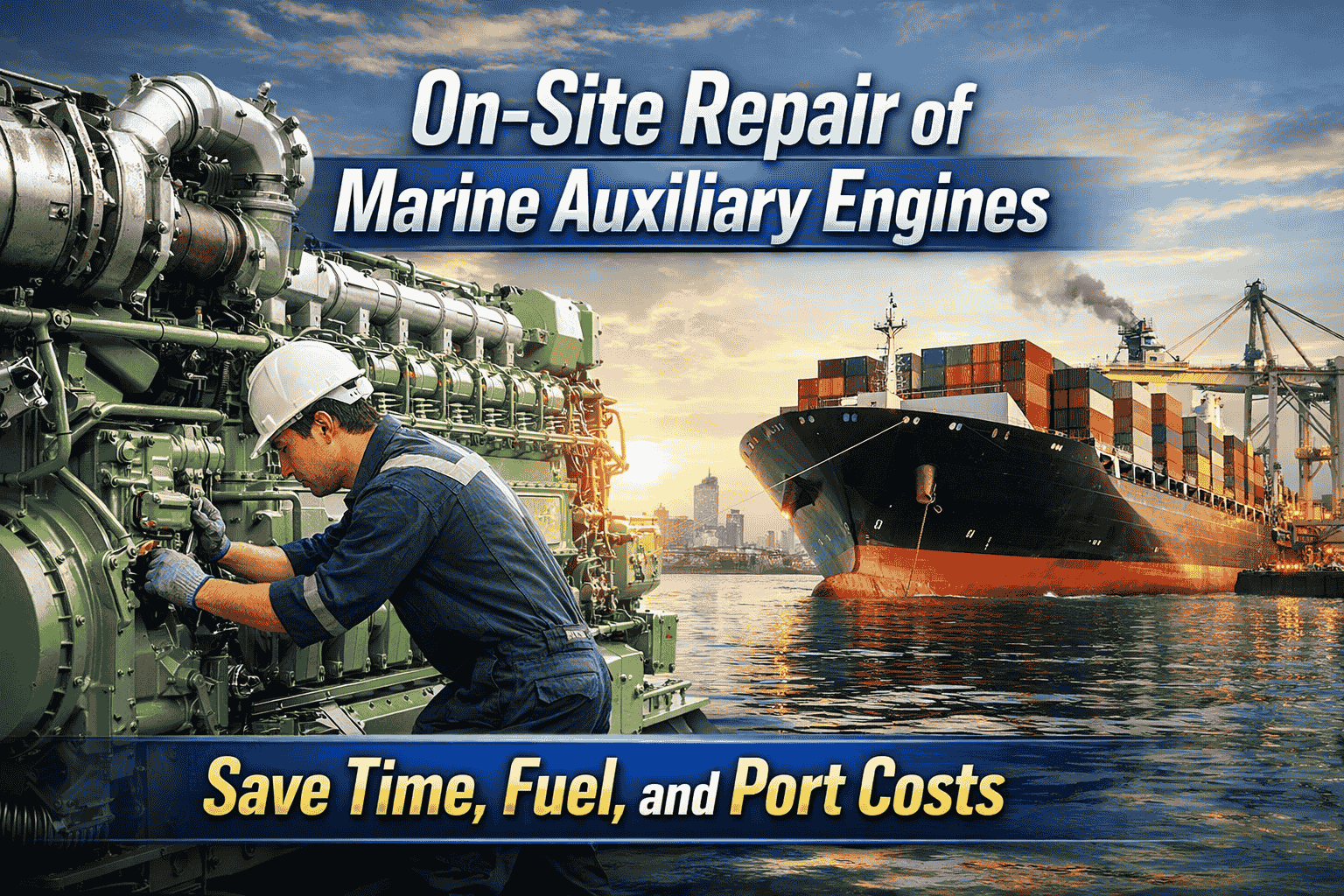
15 Apr On-Site Repair of Marine Auxiliary Engines: Save Time, Fuel, and Port Costs
Unexpected engine issues can disrupt operations and increase costs quickly in marine environments. That’s why on-site repair of marine auxiliary engines has become a smart and efficient solution for vessel owners.
Instead of moving the ship to a port or dry dock, technicians perform repairs directly on board. This approach saves time, reduces fuel consumption, and avoids high port charges, ensuring faster and more cost-effective operations.
Here, we will discuss On-site Repair of Marine Auxiliary Engines in detail.
What Are Marine Auxiliary Engines and Why Do They Matter?
Marine auxiliary engines are support engines that provide power to essential onboard systems in a ship. They run equipment like generators, pumps, compressors, navigation systems, and lighting, ensuring smooth and safe vessel operations. They:
- Supply power to essential onboard systems.
- Support operation of critical ship equipment.
- Ensure smooth and safe vessel functioning.
- Maintain crew comfort and onboard environment.
- Prevent operational disruptions during voyages.
The Hidden Costs of Traditional Off-Site Engine Repair:
The traditional off-site repair method requires a ship to be relocated to a port which includes dry dock facilities. It requires substantial time to complete while it hampers the entire operational process.
Off-site repair work leads to increased fuel use and higher port expenses. Vessel owners must pay docking charges and labor costs and logistics expenses. The traditional repair methods become costly and inefficient because of hidden costs which exceed modern solutions.
What Is On-Site Repair of Marine Auxiliary Engines?
On-Site Repair of Marine Auxiliary Engines involves repairing and servicing engines directly at the vessel’s location. The technicians bring essential specialized tools and equipment to the ship which eliminates the requirement for ship movement towards a repair facility.
The system uses specialized methods which include In-Situ Crankshaft Grinding and alignment correction and component replacement. Engineers execute their exact repair work while the engine stays in its current position. It helps them finish their tasks more efficiently and their work interruptions decrease.
Key Benefits: Time, Fuel, and Port Cost Savings:
Marine Auxiliary Engine On-Site Repair provides numerous benefits when compared to conventional repair techniques. It helps ship operators decrease both their system unavailability periods and their maintenance expenses and also their supply chain problems.
Here are the key benefits in detail:
- Time Savings
The repair process begins as soon as technicians finish their initial work. Quick repairs permit vessels to continue their activities after short breaks. This leads to better schedule management which eliminates revenue loss from scheduled downtime.
The docking process decreases fuel expenses because it reduces operational needs and equipment operation time. The delivery system enables ship owners to continue their business activities while meeting their shipping deadlines.
- Fuel Savings
The repair process needs no vessel transportation to different repair stations. The system needs no transportation because it keeps the vessels at their repair location which leads to decreased fuel usage and operational expenses.
Fuel savings become significant for large vessels that consume high amounts of fuel. Avoiding unnecessary movement helps optimize overall cost efficiency.
- Port Cost Savings
The standard repair process requires ship operators to spend money on both docking fees and port charges and labor expenses. The process of on-site repair work enables the operator to eliminate several cost elements.
Shipowners save money by avoiding extended port stays. They only pay for the repair service instead of additional operational costs.
Common Auxiliary Engine Problems Fixed On-Site:
Technicians can resolve auxiliary engine difficulties through their on-site repair services. The repairs enable engines to function normally again because they do not require engine removal. Here are common Auxiliary Engine problems fixed on-site:
- Crankshaft Wear and Damage
Technicians use In-Situ Crankshaft Grinding to repair worn or damaged crankshaft journals. The process restores surface smoothness which leads to better engine performance.
- Bearing Failures
Vibration and noise result from worn or damaged bearings. The on-site repair process involves replacing defective bearings while the team ensures correct positioning of equipment.
- Misalignment Issues
Engine misalignment causes operational inefficiency while damaging engine components. Technicians use alignment correction methods to achieve proper operational functionality.
- Cylinder Wear
Engine performance decreases because of cylinder wear. On-site honing and repair techniques restore cylinder efficiency.
- Oil Leakage Problems
Leaks create lubrication shortages which result in component damage. The on-site repair team quickly locates and repairs all identified leakage points.
On-Site Repair Process: How It Works Step by Step:
Marine Auxiliary Engine On-Site Repair begins with a defined workflow which leads to precise and effective outcomes. The process requires specific methods which ensure both accurate results and protection of personnel.
Here is step by step process that how on-site repair process work:
Step 1: Inspection and Diagnosis
The technicians examine the engine to find its primary issue. The technicians use advanced equipment to determine the extent of the damage.
Step 2: Planning and Preparation
The experts develop a repair strategy while they gather necessary tools and materials for the job. Proper preparation ensures smooth execution.
Step 3: Repair Execution
Technicians complete their repairs through the use of dedicated repair tools. The technicians complete their repairs while the engine remains on the ship.
Step 4: Testing and Quality Check
The engine needs to pass tests after the repairs because they confirm its proper operation. This procedure confirms that both performance and safety standards have been met.
Step 5: Step 5: Final Handover
The repaired engine is handed over after successful testing. Technicians provide maintenance guidance to prevent future issues.
Tools and Technology Used in On-Site Marine Engine Repair:
The On-Site Repair process requires modern tools and technology to achieve both efficient work and precise results. The tools enable technicians to conduct high-quality repairs without having to take apart the entire engine.
Here are the tools and technology used in on-site Marine engine repair-
- In-Situ Grinding Machines
The machines execute In-Situ Crankshaft Grinding operations directly on the vessel. The machines restore journal surfaces with high precision.
- Alignment Tools
Laser alignment tools provide precise engine alignment results. The tools decrease vibration levels while they enhance operational efficiency.
- Portable Machining Equipment
The portable tools enable technicians to perform engine component machining directly at the site. The tools allow technicians to restore parts while keeping them attached to the system.
- Diagnostic Equipment
The advanced diagnostic tools enable engineers to find faults in a short time. The technology enhances accuracy while it decreases the time needed for repairs.
Choosing the Right On-Site Marine Engine Repair Service:
The successful on-site repair of marine auxiliary engines requires you to choose the appropriate repair service provider. The service provider who delivers trustworthy services will maintain product quality while ensuring safety and delivering enduring results.
Here are the factors you must consider while choosing the right on-site Marine engine repair service:
- Experience and Expertise
You should select a service provider who has established a record of marine engine repair work. The technicians who possess advanced skills can solve complicated engines and deliver outstanding results.
- Advanced Equipment
A good service provider uses modern tools and technology. The advanced equipment enables precise repairs which lead to faster completion times. The latest tools help technicians to enable technicians to perform repairs that require advanced skills
- Service Availability
Look for providers who can provide immediate assistance across all their international locations. The organization benefits from decreased operational interruptions because its resources become accessible at a faster rate.
- Customer Support
Excellent customer support is what empowers the businesses to share the problems briefly and an expert who considers the real issues assists beyond engine maintenance work. Good customer support always strengthens the professional relationships and delivers enhanced service experience.
Is On-Site Repair Right for Your Vessel?
On-Site Repair of Marine Auxiliary Engines is ideal for vessels that need quick and cost-effective solutions. The method achieves optimal results when technicians can fix damages without needing to extract the entire engine. This on-site procedure enables organizations to keep running their activities while experiencing minimal interruptions.
FAQs:
- What types of marine auxiliary engines can be repaired on-site?
Technicians can repair most diesel and generator auxiliary engines on-site. The team possesses the capability to resolve issues related to component damages and alignment errors through effective maintenance procedures.
- How much time can on-site repair of marine auxiliary engines save compared to dry dock servicing?
On-site repair can save several days or even weeks. It removes the need for dock time which allows the repair work to proceed at a faster pace.
- Is on-site repair of marine auxiliary engines safe and up to industry standards?
Yes, professionals follow strict safety and quality standards. The technicians utilize cutting-edge equipment to perform trustworthy and precise repair work.
- How do I know if my auxiliary engine needs immediate on-site repair or a full overhaul?
The testing process requires you to check for indicators which include audible sounds and vibration patterns and performance decreases. The specialists will evaluate the situation to provide their recommendation about which solution works best.
- What are the cost differences between on-site repair and traditional port-based marine engine servicing?
On-site repair costs less because it avoids port charges and fuel expenses. The conventional methods require organizations to spend extra money on their daily activities and transportation needs.
No Comments