


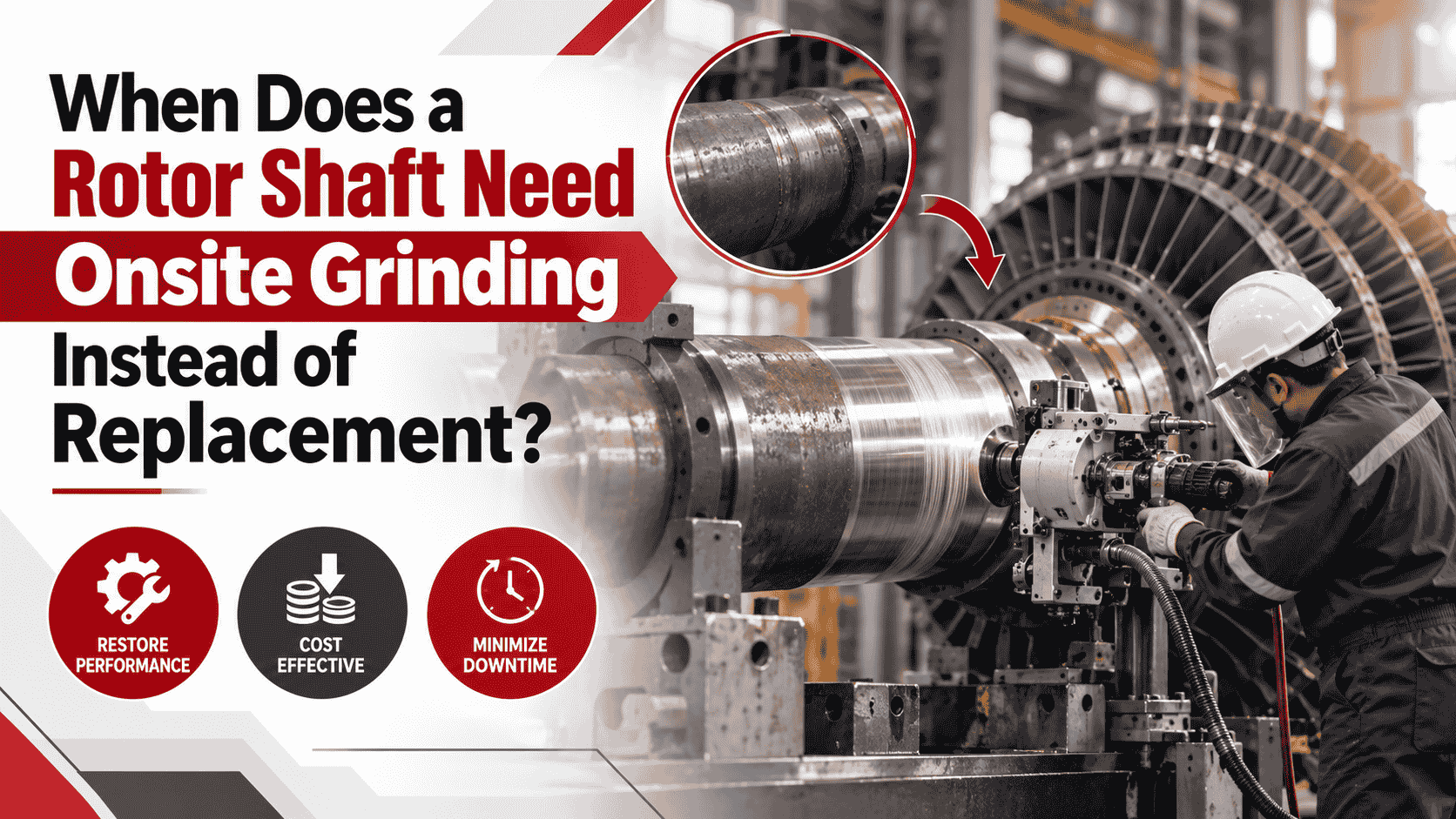
When Does a Rotor Shaft Need Onsite Grinding Instead of Replacement?

When Does a Rotor Shaft Need Onsite Grinding Instead of Replacement

When Does a Rotor Shaft Need Onsite Grinding Instead of Replacement?

A damaged rotor shaft can quickly become a real problem for your engine operations. Remember, rotor shafts deal with heavy pressure and heat that cause excessive wear, corrosion, bearing damage, and poor alignment very often.

All these lead to the following:

  • Less performance
  • Vibration
  • Heat
  • Noise
  • Unexpected equipment failure

Such conditions often lead to one important question:

Marine & Industrial Engine Repair

Engine Down? Every Hour Costs You.

In-situ crankshaft grinding, engine overhauls, line boring & onsite repair — tell us the problem and get a response within hours.

+91 98112 82433 · info@mpapowerproject.in

Should you repair the rotor shaft or completely replace it?

In many cases, repair does the job, reducing downtime, saving time, and minimising costs & workload. But on-site repairing is not suitable for every type of damage.

Now, what should you choose? In this blog, we will discuss the situations when you should choose one of them.

What Is Rotor Shaft Grinding Onsite?

Rotor shaft grinding onsite is a precise in-situ grinding procedure that restores the dimensions and surface conditions of the rotor shaft.

Notably, in this process, you don’t need to dissemble the rotor, so it clearly saves transportation costs, logistical costs, and downtime.

The technicians use portable grinding equipment and carefully remove the damaged materials from the shaft surface. Then, they restore the shaft as per the manufacturer’s measurement about diameter, roundness, concentricity, and surface finish.

In-situ grinding is highly helpful in large shafts that are difficult, expensive, or need a heavy workforce to remove.

The technicians remove only a small amount of material [a few tenths of a millimetre] to give a clean and accurate surface finish.

Common Causes of Rotor Shaft Damage:

Here are the common causes of rotor shaft damage:

  1. Wear

The rotor shaft stays in contact with bearings, seals, or other components continuously. This often causes material loss. Over time, the wear may produce grooves, scoring, pitting, or changes in shaft diameter. Sometimes, even a small dimensional change can affect bearing fit and cause misalignment.

  1. Corrosion

Moisture, chemicals, saltwater, and aggressive operating environments often cause corrosion. Such conditions are very common for marine engines. Most of the corrosion pits give stress to the whole system and accelerate the deterioration.

  1. Bearing Failure

A damaged bearing increases the risk of bearing failure. It causes excessive friction and movement around the shaft, creating deep scoring, overheating, or uneven wear. But you must look for the underlying issues. If core issues are not solved, grinding alone will not provide a long-term solution.

When Onsite Grinding Is the Best Option?

  1. Minor to Moderate Damage

Rotor shaft grinding onsite is generally useful when the rotor shaft has limited damage. Plus, the rotor shaft has enough material remaining to restore the required dimensions.

Here are the most common repairable conditions such as:

  • Surface wear
  • Light scoring
  • Corrosion pitting
  • Localised damage
  • Minor out-of-round conditions
  • Seal and bearing journal damage

However, technicians must measure the shaft carefully. Measure diameter, runout, surface condition, hardness, and the extent of material loss before engineers start grinding.

  1. Downtime Considerations

Downtime is extremely expensive, especially in heavy industries where engines work all the time. In such settings, removing the whole motor means you will have to disconnect every line, lift equipment, and transport them to the workshop.

This takes time from a few weeks to over a month. The downtime can seriously impact the overall profits.

On-site grinding removes all those activities and allows the repair team to focus on the repair directly. For a critical rotating machine, saving even one or two days of downtime means a significant financial recovery.

  1. Cost Comparison

You may feel replacement is a straightforward solution, but its costs go beyond a new shaft. A replacement often involves the following as well:

  • New shaft manufacturing
  • Transportation
  • Crane or lifting arrangements
  • Dismantling
  • Installation
  • Alignment
  • Commissioning
  • Extended production losses

When compared, the onsite rotor shaft repair can reduce transportation and dismantling costs. However, it depends on shaft size, material, location, damage severity, and machine type.

When Replacement Becomes Necessary?

Onsite grinding is not a universal solution. When damages are severe, replacement is a safer and more economical option.

  1. Severe Structural Damage

Grinding removes material, so it can’t solve a problem when there is very little material left on the shaft surface. It can make the shaft surface too small or compromise its strength.

Always choose replacement in the following conditions:

  • Deep cracks
  • Major fractures
  • Severe bending
  • Extensive material loss
  • Serious metallurgical damage
  • Damage beyond repairable journal area. 

Note:

Technicians often use non-destructive testing methods such as magnetic particle inspection or ultrasonic testing to identify cracks or other internal or surface defects.

  1. Safety Concerns

Heavy industries work under critical conditions, so they are always under potential risks. Any shaft must be capable of handling the machine’s operating loads after repair.

A shaft that looks good externally but has defects may not work accordingly, and they can affect its structural integrity.

An expert must consider the following factors before a repair:

  • Operating speed
  • Stresses
  • Shaft material
  • Balance requirements
  • Manufacturer specifications

Note: Keep safety as your utmost priority.

Advantages of Onsite Grinding:

Onsite shaft grinding reduces downtime as it removes the need for transportation, dissembling, and reinstalling the rotor.

Large industry rotors can weigh several tonnes. They need cranes and special lifting equipment to remove them.

Repairing a shaft is more affordable than replacing it. The new shaft will need manufacturing and installing. It can also reduce transportation, lifting, and installation expenses.

Modern portable onsite grinding tools are highly precise. Today, technicians can achieve OEM guided dimensional tolerance and surface finishes.

Industries That Benefit From Onsite Grinding:

  1. Marine

Onsite grinding becomes highly useful in marine industries as they can’t transport the rotor shaft easily. Components such as propulsion shafts and stern tubes can experience wear and corrosion. Repairing them onsite is highly valuable and cost-effective.

  1. Industrial Plants

Heavy industrial plants such as steel plants, cement plants, refineries, and process industries depend on rotating machinery. They need quality repair services with minimal downtime. Repairing shafts onsite can help reduce production downtime, which is essential for such industries.

  1. Power Generation

Power plants rely on turbines, generators, pumps, compressors, and other rotating equipment. This equipment is essential to operating the plants; they need rapid and accurate shaft repair. Onsite grinding offers quality repair services during planned or emergency maintenance.

How Professionals Perform Onsite Grinding?

Here is how a professional rotor shaft grinding onsite process works:

  1. Inspection

Technicians first inspect the shaft, find the core issues, and assess the severity of damage. They measure diameter, runout, roundness, and surface condition. When needed, they also perform non-destructive testing methods.

  1. Precision Machining

After inspection, the technicians mount the portable grinding equipment around the shaft. They carefully remove the damaged materials and maintain the correct alignment.

  1. Final Testing

After grinding, technicians check the dimensions and surface finishes. Depending on the application, they may also verify runout, journal dimensions, surface finish, hardness, and alignment.

Only after the final testing and achieving OEM measurements, the machine returns to its original services.

Marine & Industrial Engine Repair

Engine Down? Every Hour Costs You.

In-situ crankshaft grinding, engine overhauls, line boring & onsite repair — tell us the problem and get a response within hours.

+91 98112 82433 · info@mpapowerproject.in

Conclusion:

Choosing between rotor shaft grinding onsite and replacement is more than just looking at the visible damage. The expert engineer first checks the shaft properly. They inspect the structural condition, dimensional requirements, machine criticality, repair cost, and expected operating life.

  • For minor or limited surface damage: Choose on-site grinding
  • For severe damages and structural issues: Choose complete replacement

Remember, on-site grinding can reduce downtime and lower overall repair costs.  But it needs expert technicians like the MPA Power Project.

Remember, the key is deep inspection and choosing the right inspection methods.  

No Comments

Post A Comment

Open chat