



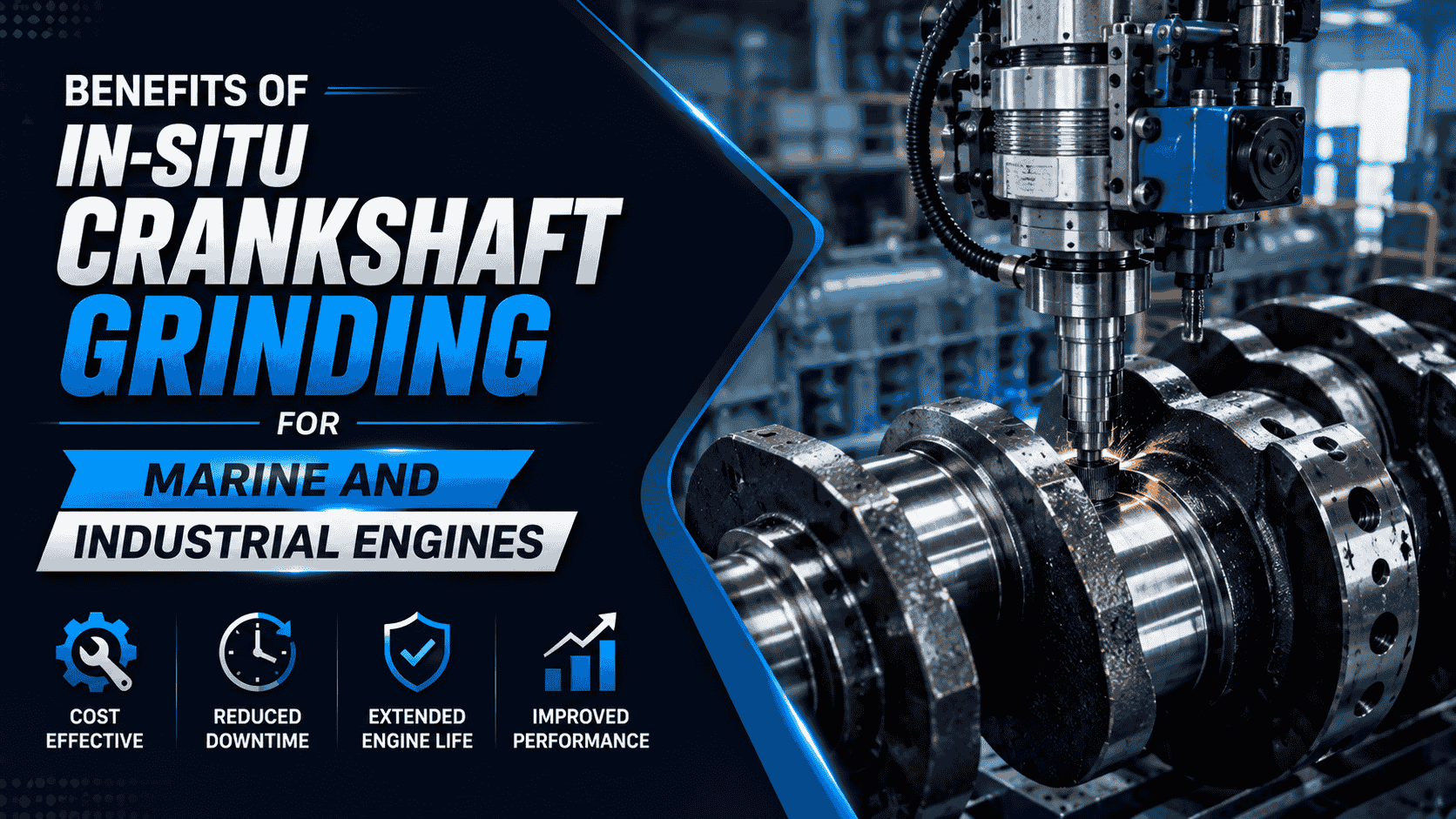
14 Jul Benefits of In-situ Crankshaft Grinding for Marine and Industrial Engines
Marine and industrial engines work under some very demanding conditions; they often get damaged and need repairing as fast as possible. Whether it’s cargo ships, offshore vessels, power plants, manufacturing facilities, or heavy industrial equipment, these engines operate for thousands of hours under high loads.
This directly affects the crankshafts.
Traditional repairs need the complete removal of the crankshaft and transportation to the workshop. But the modern and industrial marine crankshaft grinding techniques have brought the In-Situ Grinding process that can do all the repairing directly at the site.
Now, the question is how beneficial is In-Situ Grinding.
Understanding Crankshaft Wear in Marine and Industrial Engines:
The crankshaft converts the piston movement into rotational power. Since it continuously handles the mechanical pressure, it often gets worn over time.
Here are some of the most common reasons for crankshaft damage:
- Poor lubrication
- Bearing failures
- Metal fatigue
- Overheating
- Misalignment
- Excessive engine vibration
- Contaminated lubricating oil
- Heavy operational loads
These can cause scoring, ovality, taper wear, cracks, or journal damage. In the worst case, it leads to expensive repairs and a long shutdown.
The modern industrial engine crankshaft repair uses portable grinding tools to repair the engine without removing the crankshafts.
Why In-situ Grinding Has Become the Preferred Repair Method?
Several industries like shipping, power generation, mining, manufacturing, and oil & gas prefer the in-situ crankshaft grinding because it solves one of the biggest challenges: DOWNTIME.
According to research by Siemens, the Fortune Global 500 companies approximately lose nearly 11% their annual revenue due to unplanned downtime.
Similarly, a study by Senseye states that large industries often struggle with 25 hours of unplanned downtime every month and lose approximately US$129 million annually per plant.
This becomes especially important for marines where reducing shipping cost and boosting global supply needs to be efficient, fast, and consistent.
In-Situ Grinding directly eliminates downtime from several weeks to just a few days and maintains OEM accuracy tolerances.
Key Benefits for Marine Engines:
- Significantly Reduces Vessel Downtime:
In-Situ grinding reduces the repair time from a few weeks to a few days only. The process cuts the time needed for crankshaft removal, transportation, and workshop machining and approximately reduces the downtime by 60-80%. On-board marine crankshaft grinding means less idle vessels and fewer losses in revenue.
- Eliminates Engine and Crankshaft Removal:
Marine engine rooms are generally compact and very difficult to manage. Removing the whole crankshaft will require:
- Extensive dismantling
- Heavy lifting equipment
- Crane arrangements
- Specialized transportation
- Reinstallation and alignment
In-situ grinding removes all these and minimises the labour and operational requirements.
- Prevents Additional Delays During Port Stay
International ports often have very tight maintenance schedules. This means waiting for clearances, availability, or replacement can take a long time.
In-situ marine crankshaft grinding avoids the logistical, approvals, and transportation challenges. Furthermore, it also minimises the risk of corrosion when the engine is dismantled for a long period.
Key Benefits for Industrial Engines:
- Minimises Production Shutdown
Some of the top industries using large industrial diesel engines are:
- Power plants
- Cement plants
- Steel industries
- Mining operations
- Manufacturing facilities
- Oil and gas installations
- Compressor stations
Large industrial plants lose over 25 hours each month to unplanned downtime. Dismantling, heavy lifting equipment, transportation, and reinstallation keep the operations down for even weeks.
In-situ industrial engine crankshaft repair eliminates all these steps and resumes the work in a much shorter time.
- Reduces Transportation and Rigging Costs
Large industrial crankshafts can weigh from hundreds of kilograms to more than 20 tonnes. An industrial engine crankshaft repair would need
- Detailed lift planning
- Certified rigging personnel
- Heavy-duty cranes
- Specialized trailers
- Transportation to a machine shop
- Machine shop facilities
- Reinstallation and alignment.
- Workshop machining charges
- Labour charges
In-situ eliminates all the needs to transport the crankshaft that allows faster repair with fewer resources.
Extends the Service Life of the Crankshaft
Replacing a crankshaft is not always possible. They cost a lot of money, and in-situ industrial engine crankshaft repair can save it. When you find the wear early, use precision grinding to restore the damaged journals while maintaining dimensional accuracy as well.
This improves the crankshaft’s life and postpones costly replacements.
Technical Advantages of In-situ Crankshaft Grinding:
In-Situ grinding is not just for saving time or postponing the costly replacement. In fact, modern portable grinding systems now deliver accuracy comparable to workshop grinding.
Precision Grinding to OEM Standards
Professional In-Situ Grinding experts use tools to measure and maintain:
- Journal diameter
- Ovality
- Taper
- Surface finish
- Run-out
With these precision tools, the In-Situ grinding machines now deliver accuracy and maintain OEM tolerances for performance and engine reliability.
Maintains Shaft Alignment
Removing the crankshaft and reinstalling it always has some alignment risks. On the other hand, In-situ grinding repairs the crankshaft in its position, and it maintains the original alignment.
Reduces Vibration and Bearing Wear
Uneven journal vibrations often lead to:
- Bearing wear
- Seal failures
- Reduced lubrication performance
- Higher operating temperatures
In-situ grinding ground the crankshaft journals that restore smooth bearing contact and improve the engine balance. This reduces the overall mechanical stress.
In-situ Grinding vs Traditional Crankshaft Repair:
| Factor | In-situ Grinding | Traditional Workshop Repair |
| Engine removal | No | Yes |
| Crankshaft transportation | No | Yes |
| Heavy cranes | No generally | Yes |
| Downtime | A few days only | Several weeks |
| Logistics cost | Low | High |
| Impact on production | Minimal | Significant |
| Installation Risk | Low | High |
Note: In-situ grinding also saves you money by avoiding:
- Lost production
- Vessel delays
- Transportation charges
- Extensive labor
Maintenance Tips to Extend Crankshaft Life:
Whether you prefer in-situ grinding or traditional workshop repair, it doesn’t replace regular maintenance. Follow all the practices to maximise the crankshaft life.
- Lubricate your bearing and crankshaft journals regularly to detect contamination, metal particles, coolant leaks, and lubrication problems.
- Check for any unusual engine vibrations.
- Schedule a regular inspection period based on engine operating hours.
Why is the MPA Power Project the Right Partner?
Choosing an experienced repair company is as important as choosing the repair method. Because professionals like MPA Power Project specialise with modern tools and procedures and maintain the fine OEM tolerances [10-25 μm] along with high-quality workmanship.
MPA Power Points offers:
- Experienced technicians
- Advanced grinding machines
- Precise repair
- High-quality finishing
- Fast response
- Less downtime
- Documentation
- OEM standard repair
- Custom solutions for industries.
MPA Power Project covers a wide range of diesel engines and provides on-call, on-site support for multiple heavy-duty industries.
MPA Power Project combines expertise, precision, and rapid response, reducing the overall maintenance costs.
Conclusion:
Crankshaft wear is common in all industries. The traditional industrial or marine crankshaft grinding takes a longer shutdown and incurs expensive costs. But the modern in-situ grinding provides precise on-site repair and reduces the downtime dramatically.
Likewise, industrial engine crankshaft repair minimises the losses and maintenance cost, and increases the equipment life in factories, power plants, and heavy industries.
Specialists like MPA Power Project provide you with accuracy and within the OEM specifications of 10-25 μm, offering reliability, maintenance, and operational efficiency.
FAQs:
- Why is in-situ grinding preferred for marine engines?
In-Situ grinding repairs the engine crankshaft in its installed vessels. This saves significant time, reduces repair costs, and avoids logistical challenges.
- Can in-situ grinding be done while the vessel is docked for a short period?
Yes. In-situ grinding minimises the downtime and repairs the crankshafts efficiently within routine time only.
- What industrial engines benefit most from this service?
Industrial engine crankshaft repair benefits the most to industries like Power generation, heavy stationary diesel engines, compressors, mining equipment, and heavy-duty industries.
- Does in-situ grinding affect the engine’s warranty?
No. If done by qualified technicians like MPA Power Plant who follow OEM tolerances, it generally doesn’t affect warranties. However, you should verify conditions.
- How often should crankshafts be inspected for wear?
Inspect your crankshaft every few thousand operating hours. This is your essential preventive maintenance program. However, the intervals may depend on engine type, operating hours, load conditions, and manufacturer recommendations.
No Comments