



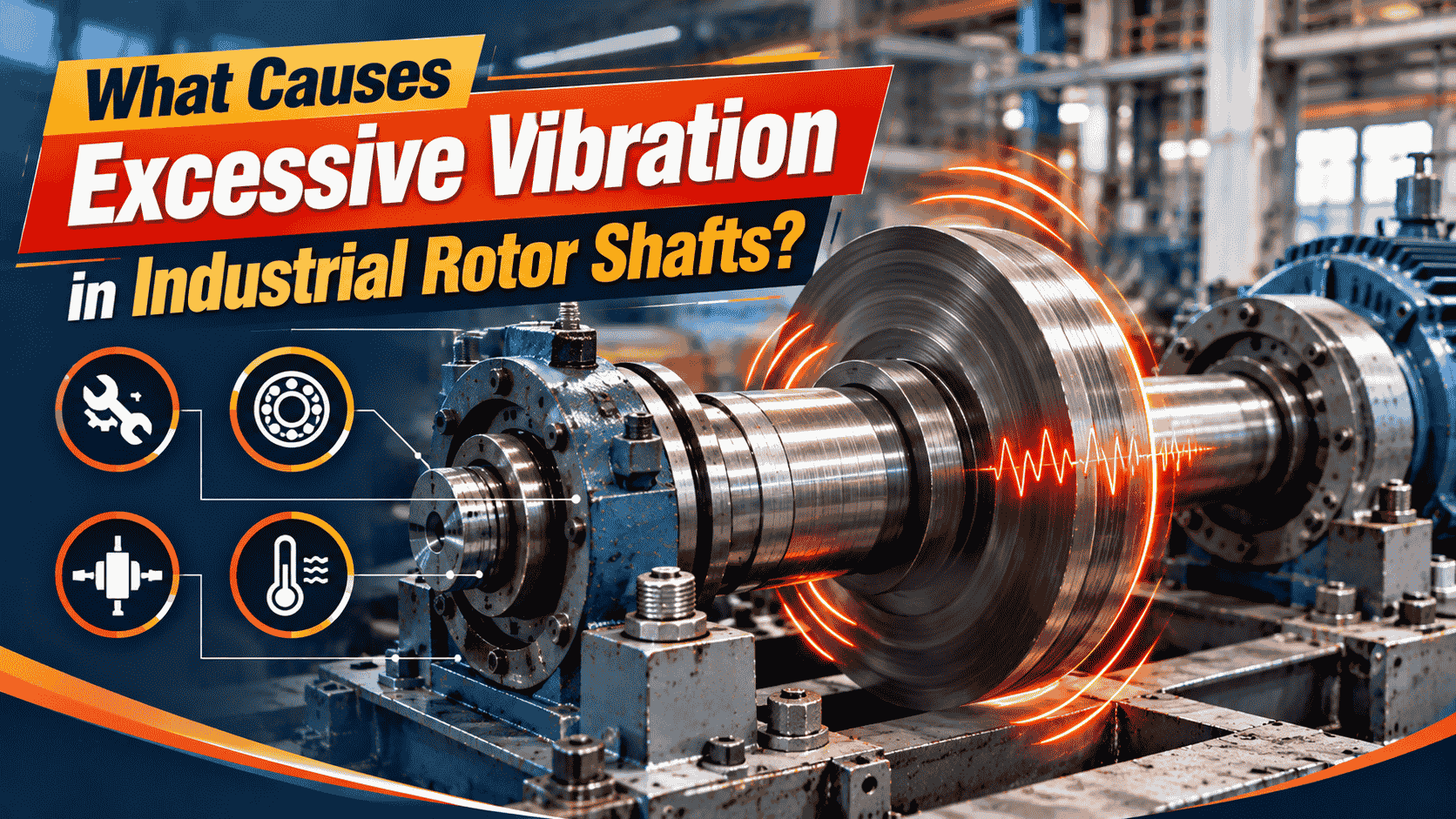
04 Nov What Causes Excessive Vibration in Industrial Rotor Shafts?
Every rotating machine vibrates a little. A turbine, a compressor, a large motor or a fan will always produce some movement when it runs. That is normal. The problem starts when that vibration grows beyond safe limits. Bearings heat up, seals start leaking, noise increases and, if nobody acts, the shaft or the whole machine can fail.
At MPA Power Project, our field teams work on rotor shafts in power plants, sugar mills, cement plants, steel units and ships. One question we hear again and again from plant engineers is simple: “Why is my rotor vibrating so much?” In this guide, we explain the most common causes of rotor shaft vibration in plain words, how to spot them early and what you can do about each one.
Why Excessive Vibration Is a Serious Warning Sign
Vibration is the language of a rotating machine. When something is wrong inside, vibration is usually the first thing that changes, long before a part actually breaks. Ignoring it can lead to:
- Faster wear of bearings, seals and couplings
- Scoring and ovality on shaft journals
- Higher power consumption and lower output
- Cracks in the shaft, foundation or casing
- Sudden, unplanned shutdowns that cost far more than planned repairs
International standards such as ISO 20816 (earlier ISO 10816) give vibration severity zones for different machine classes. Most plants use these zones to decide when a machine is “good”, “acceptable”, “needs attention” or “must stop”. If your readings are creeping toward the higher zones, it is time to find the root cause.
9 Common Causes of Excessive Vibration in Industrial Rotor Shafts
1. Rotor Imbalance
Imbalance is the most common reason behind high vibration. It happens when the mass of the rotor is not evenly spread around its centre of rotation. Even a small uneven weight creates a strong force at high speed.
Common reasons for imbalance:
- Dirt, scale or product build-up on blades and impellers
- Erosion or corrosion of blades
- A broken or missing blade, bolt or balance weight
- Poor balancing after a repair or overhaul
How it shows up: A strong vibration peak at running speed (called 1X) in the radial direction, which rises sharply as speed increases.
2. Shaft Misalignment
When the driver and the driven machine are not on the same centreline, the coupling forces the shafts to bend and push against each other. This can be angular misalignment, parallel (offset) misalignment or a mix of both.
Misalignment often appears after a foundation settles, after maintenance work, or because of thermal growth when the machine reaches operating temperature. It usually shows a high 2X peak and strong axial vibration. Laser alignment, done both cold and with thermal growth in mind, is the best fix.
3. Bent or Bowed Shaft
A shaft can bend because of uneven heating, a rub, sudden stopping, or long periods of standing still without barring (turning gear). Large turbine rotors are especially prone to a temporary or permanent bow. A bent shaft behaves much like imbalance and misalignment combined, so it is often misdiagnosed. A run-out check with dial gauges along the length of the shaft gives a clear answer.
4. Worn, Scored or Oval Journals
The journals are the parts of the shaft that sit inside the bearings. Over time, poor lubrication, contaminated oil or hard particles can score these surfaces. Journals may also become oval or tapered. When this happens, the oil film inside the bearing cannot stay stable, and the shaft starts to move more than it should.
This is one of the areas where we see the biggest improvement after repair. Restoring the correct size, roundness and surface finish through turbine rotor shaft grinding services often brings vibration back within limits without replacing the rotor.
5. Bearing Problems
Bearings support the rotor and control its movement. When they wear out, the shaft loses that support. Typical bearing faults include:
- Excessive clearance in journal (sleeve) bearings
- Damaged or wiped white metal (babbitt) lining
- Pitting or spalling in rolling element bearings
- Oil whirl or oil whip caused by an unstable oil film
For sleeve bearings with damaged lining, bearing rebabbitting services restore the original clearance and give the shaft a stable surface to run on again.
6. Mechanical Looseness
Loose foundation bolts, cracked baseplates, a soft foot under a machine leg, or a bearing that is loose in its housing all allow parts to move freely. Looseness tends to produce many harmonics (2X, 3X, 4X and more) and a vibration pattern that looks “messy” on the spectrum. Checking bolt torque and soft foot is a quick, low-cost first step.
7. Bore Misalignment in Housings
Sometimes the shaft and bearings are fine, but the housings that hold the bearings are not in a straight line. This is common in older machines, cement mills and large engines where the casing has distorted over years of heat and load. In these cases, on-site line boring and repair corrects the bore alignment so the rotor can run true.
8. Resonance
Every structure has natural frequencies. If the machine’s running speed is close to one of them, even a small force gets amplified into very high vibration. Resonance often appears after a speed change, a new foundation or a structural modification. A bump test or a run-up/coast-down test helps confirm it. The fix may involve changing stiffness, adding mass or changing the operating speed.
9. Rubbing, Cracks and Process Issues
Other causes include rotor-to-stator rub, a cracked shaft (very dangerous, often seen as a changing 1X and 2X response), thermal distortion, and process factors like cavitation in pumps or surge in compressors. For compressors in particular, damaged shafts are a frequent reason for repeat vibration trips, and compressor shaft grinding is often part of the solution.
Quick Reference: Vibration Symptom vs Likely Cause
- High 1X radial vibration: Imbalance or bent shaft
- High 2X and strong axial vibration: Misalignment
- Many harmonics (2X, 3X, 4X): Mechanical looseness
- Sub-synchronous peak (around 0.4X–0.48X): Oil whirl in sleeve bearings
- High-frequency bearing tones: Rolling element bearing defects
- Vibration very high only at one speed: Resonance
Use this as a starting point only. A proper diagnosis needs measured data, spectrum analysis and a physical inspection.
How to Diagnose Rotor Shaft Vibration Step by Step
- Collect readings: Measure vibration at each bearing in horizontal, vertical and axial directions. Compare with past trends and ISO limits.
- Analyse the spectrum: Look for 1X, 2X, harmonics and sub-synchronous peaks to narrow down the cause.
- Check the basics: Bolt tightness, soft foot, coupling condition and lubrication quality.
- Check alignment and run-out: Use laser alignment tools and dial gauges on the shaft.
- Inspect journals and bearings: Measure ovality, taper, surface damage and bearing clearances.
- Repair and verify: Fix the root cause, then re-measure vibration to confirm results.
When the inspection shows journal damage, you do not always need to remove the rotor and ship it to a workshop. Understanding when rotor shafts need onsite grinding helps you choose the fastest and most economical route.
How to Prevent Excessive Vibration in the Future
- Follow a condition monitoring plan: Regular vibration readings help you catch problems early.
- Keep oil clean: Good filtration and regular oil analysis protect journals and bearings.
- Balance after every major repair: Never return a rotor to service without proper balancing.
- Re-check alignment: Do it after maintenance, foundation work or any major temperature change.
- Use turning gear correctly: This prevents bowing of large turbine rotors during shutdown.
- Repair early: A small journal scratch is much cheaper to fix than a seized bearing.
How MPA Power Project Helps Fix Vibration Problems
Our in-situ machining teams carry portable grinding and machining equipment to your site. This means we can measure, grind and polish shaft journals right where the machine is installed, often with the rotor still in place. We work on turbine rotors, compressor shafts, generator shafts and crankshafts, and we finish with a complete measurement report of size, ovality, taper and surface finish.
If you want to see what the process looks like on the ground, read our guide on how onsite rotor shaft grinding works.
Frequently Asked Questions
1. What is the most common cause of rotor shaft vibration?
Imbalance is the most common cause, followed closely by misalignment. Together they are behind a large share of vibration problems in industrial rotating machines.
2. Can worn journals really cause high vibration?
Yes. Scored, oval or tapered journals disturb the oil film inside the bearing. This makes the shaft move unevenly and raises vibration levels. Grinding the journals back to correct geometry usually solves it.
3. Is it safe to keep running a machine with high vibration?
It is not recommended. Running in the high ISO severity zones can quickly damage bearings, seals and the shaft itself. Reduce load if possible and plan an inspection immediately.
4. Do I need to remove the rotor to fix vibration issues?
Not always. Many problems, such as journal damage, can be repaired on site with in-situ grinding. This saves dismantling time, transport cost and long downtime.
5. How often should vibration be checked on critical machines?
Critical machines like turbines and large compressors are usually monitored continuously or checked weekly. Less critical equipment can be checked monthly, depending on your maintenance plan and the machine’s history.
Conclusion
Excessive vibration is never “just noise”. It is a clear message that something inside the machine needs attention, whether it is imbalance, misalignment, a bent shaft, worn journals, loose parts or bearing damage. The sooner you find the root cause, the cheaper and faster the repair will be.
If your machine is showing rising rotor shaft vibration, do not wait for a breakdown. MPA Power Project offers on-site inspection, in-situ shaft grinding, line boring and bearing repair, helping you restore smooth operation with minimum downtime. Get in touch with the MPA Power Project team today to discuss your machine and get expert support right at your site.
No Comments