



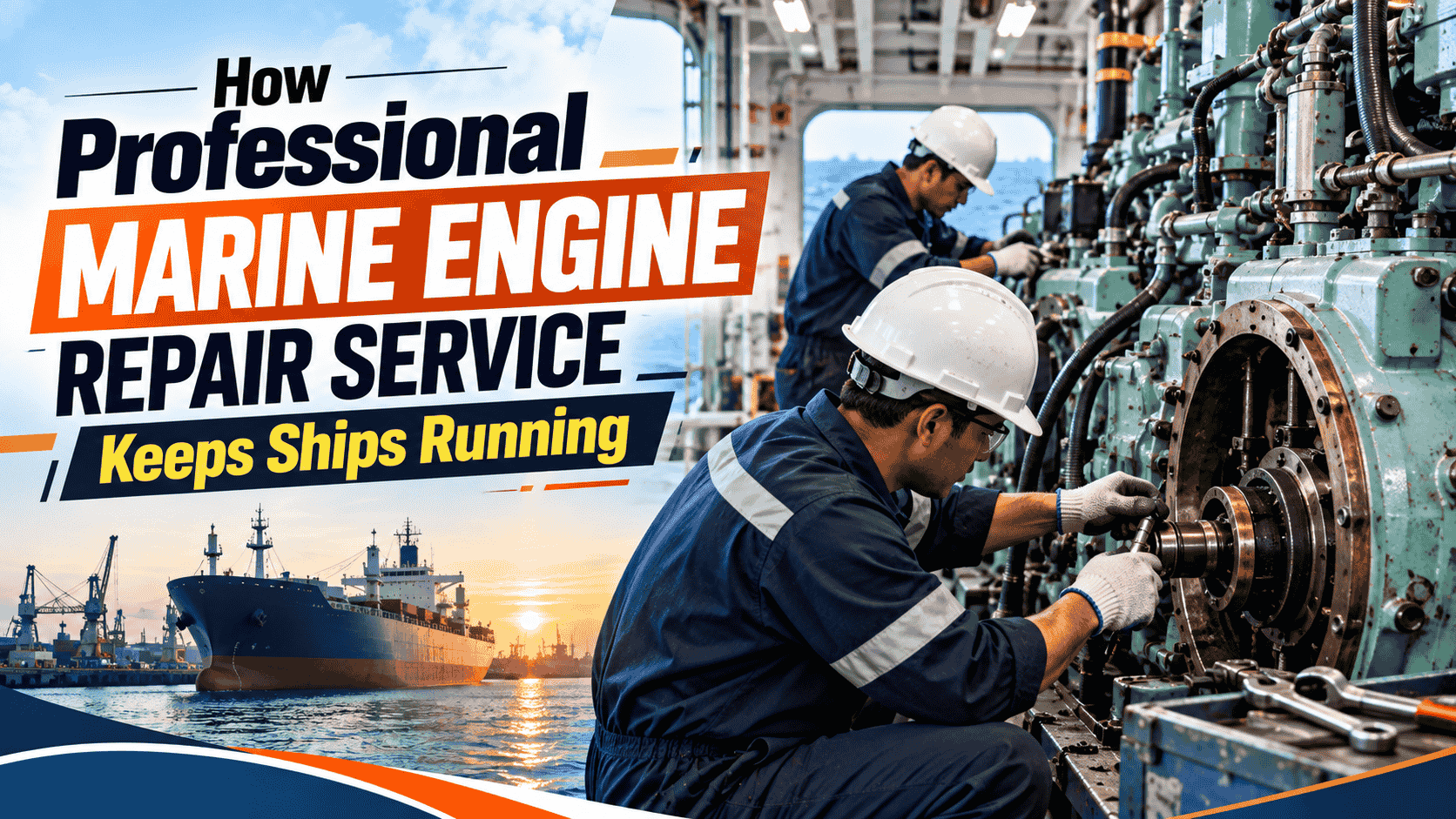
07 Oct How Professional Marine Engine Repair Service Keeps Ships Running
A ship earns money only when it moves. The moment the main engine stops, the owner starts paying for a vessel that is doing nothing: port fees, crew wages, charter penalties and missed cargo windows. Anyone who has stood in a quiet engine room while the phones keep ringing knows how heavy that silence feels.
At MPA Power Project, our engineers have spent more than 15 years working inside marine engine rooms, offshore rigs and power plant halls. We have seen what happens when repairs are rushed, and we have seen how the right repair, done at the right time, keeps a ship on schedule for years. In this guide, we share the real ways a professional marine engine repair service keeps ships running, in plain words and without the sales talk.
1. It Finds the Problem Before It Becomes a Breakdown
Most big engine failures start small. A slight rise in bearing temperature. A little more oil consumption than last month. A new knock that only shows up at a certain load. The crew often notices these signs, but they are busy running the ship and can’t always stop to dig deeper.
A professional repair team comes in with fresh eyes and proper tools. They check crankshaft deflection readings, take oil samples, measure wear on journals and look at the full running history. This is where experience matters. A trained engineer can tell the difference between a normal reading and an early warning that needs action within weeks, not months.
When a problem is caught early, the fix is usually smaller, cheaper and can be planned around the ship’s trading schedule instead of forcing an emergency stop at sea.
2. It Repairs the Crankshaft Without Removing It
The crankshaft is the backbone of the engine. When its journals get scored, worn oval or damaged by a bearing failure, many owners assume the only option is to pull the crankshaft out and send it to a workshop. On a large marine engine, that can mean weeks of downtime, heavy lifting and a very large bill.
This is where in-situ crankshaft grinding changes everything. Our team brings portable grinding machines on board and machines the damaged journals right where the crankshaft sits. There is no need to remove the engine or the shaft. The journal is ground back to a round, smooth surface within tight tolerances, checked with precise measuring tools and then prepared for new bearings.
For a ship owner, the difference is huge. A job that could keep a vessel out of service for a long stretch can often be finished in a matter of days, sometimes while the ship is at anchor or alongside the berth.
3. It Keeps Bearings Healthy So the Engine Runs Smoothly
Bearings carry the load of the rotating parts. When the white metal lining on a bearing wears out, cracks or wipes, the engine starts to vibrate, run hot and lose oil pressure. Left alone, a failed bearing can damage the crankshaft within hours.
A good repair service does not just throw in a new bearing and hope for the best. It checks why the bearing failed in the first place: poor lubrication, misalignment, dirty oil or overloading. Then it fixes the root cause. Where the bearing shell is still sound, professional bearing rebabbitting restores the white metal layer so the bearing can go back into service with a proper fit and a long working life.
Healthy bearings mean steady oil pressure, lower vibration and far less risk of a sudden stop at sea.
4. It Brings Worn Engines Back to Full Strength
Every engine has a working life, and every hour it runs adds a little wear to pistons, liners, rings, valves and fuel pumps. Over time, the engine burns more fuel, puts out less power and needs more attention from the crew.
A planned overhaul resets that clock. Professional engine overhaul services cover stripping the engine, measuring every critical part against the maker’s limits, replacing or reconditioning what is worn and putting everything back together in the correct order with the right clearances and torque values.
The result is an engine that runs cleaner, uses less fuel and is far more reliable. For owners, a well-planned overhaul is often cheaper over time than living with a tired engine that keeps causing small failures.
5. It Looks After the Auxiliary Engines Too
People often focus only on the main engine, but a ship cannot run without its auxiliary engines. These are the engines that drive the generators. They power the lights, pumps, cranes, navigation systems, cooling and even the controls of the main engine. If the generators fail, the ship can lose power completely, which is called a blackout, and that is one of the most dangerous situations at sea.
A professional team gives auxiliary engines the same care as the main engine: regular checks, crankshaft inspection, bearing work and overhauls when due. Our team regularly handles auxiliary engine repair on board, so the generators keep running while the rest of the ship carries on with its work.
6. It Works Where the Ship Is, Not Where the Workshop Is
Ships don’t wait at one port for repairs. They move between countries, anchorages and shipyards. A repair service that can only work in its own workshop is of limited use to a ship owner.
A professional marine engine repair team travels to the vessel. Our engineers carry portable machines and measuring tools and are used to working in tight engine rooms, in heat and on tight deadlines. This onsite approach saves transport time, avoids the risk of damaging heavy parts in shipping and lets the owner plan the repair around port calls.
From our experience, the ability to reach the ship quickly is often what separates a two-day delay from a two-week delay.
7. It Follows Proper Checks, Records and Class Standards
On a ship, a repair is not complete until it is recorded and accepted. Classification societies and insurers want proof that the work was done correctly. A professional repair service knows this and works in a way that makes approval easy.
That means taking measurements before and after the job, recording journal diameters, roundness and surface finish, noting crack detection results and preparing a clear report. When a class surveyor comes on board, the paperwork is ready and the readings speak for themselves.
Good records also help the owner in the future. The next team that works on the engine can see exactly what was done, when and why. That history is valuable for planning the next overhaul and spotting trends.
8. It Helps Owners Plan Maintenance Instead of Reacting to Failures
The best repair service does not just fix what is broken today. It helps the owner and the chief engineer plan what needs to be done over the next months and years. That includes advising when an overhaul is due, which parts to order in advance and how to schedule work during dry dock or planned port stays.
Regular marine engine maintenance backed by expert inspections turns engine care from a series of emergencies into a steady routine. Spare parts are ready, the right people are booked and the ship keeps sailing on schedule.
9. It Saves Money Over the Life of the Ship
It’s easy to see a professional repair service as a cost. In practice, it is one of the best ways to protect the bigger investment, which is the ship itself.
Think about where the money really goes when an engine fails:
- Lost charter income for every day the ship is idle
- Towing or emergency port costs if the failure happens at sea
- Extra damage when a small fault is ignored and spreads to other parts
- Higher fuel bills from an engine that is running below its best
- Rush charges for parts and labour ordered at the last minute
A skilled team that fixes problems correctly the first time, works on site and helps plan ahead cuts most of these costs. Over the life of a vessel, the savings add up to far more than the repair bills.
10. It Puts Experienced Hands on Critical Work
Engine repair on a ship is not a job to learn on the go. Grinding a crankshaft journal, setting bearing clearances or aligning a shaft needs people who have done it many times, on many engine types, in real conditions.
At MPA Power Project, our engineers have worked on main engines, auxiliary engines, compressors and turbines for marine and industrial clients around the world. That experience shows up in the small details: knowing which readings to double-check, how a certain engine model tends to wear and when a part can be saved or must be replaced. It’s this hands-on knowledge that gives owners confidence that the job has been done right.
Final Thoughts
A ship is only as reliable as its engines, and engines are only as reliable as the people who look after them. A professional marine engine repair service keeps ships running by catching problems early, fixing them properly on board, keeping clear records and helping owners plan ahead instead of reacting to breakdowns.
If your vessel is showing warning signs, or if you want a second opinion on an upcoming overhaul, the team at MPA Power Project is ready to help, wherever your ship is.
Frequently Asked Questions
1. How often should a marine engine be serviced by professionals?
It depends on the engine maker’s guidelines and running hours. Most marine engines have routine checks every few hundred running hours and major overhauls at set intervals given in the maker’s manual. A professional team can review your running hours and condition data and suggest a practical schedule for your ship.
2. Can a crankshaft really be repaired without taking it out of the engine?
Yes. With in-situ grinding, portable machines are set up on the crankshaft inside the engine and the damaged journals are machined in place. This saves the time and cost of removing the crankshaft and is suitable for many types of wear, scoring and ovality.
3. What are the early signs that a marine engine needs repair?
Common signs include unusual knocking or noise, higher vibration, rising bearing or exhaust temperatures, falling oil pressure, more oil or fuel consumption and changes in crankshaft deflection readings. If you notice any of these, get the engine checked before the problem grows.
4. Can repairs be done while the ship is in port or at anchor?
In many cases, yes. Professional onsite teams bring their own portable machines and can work on board during port stays or at anchorage. This helps the ship avoid long visits to a dry dock or workshop.
5. Will the repaired engine be accepted by the classification society?
When the work is done to proper standards and fully recorded, it is usually accepted after the surveyor reviews it. A professional repair team provides before-and-after measurements, crack test results and a clear report so the surveyor can approve the work without delay.
No Comments